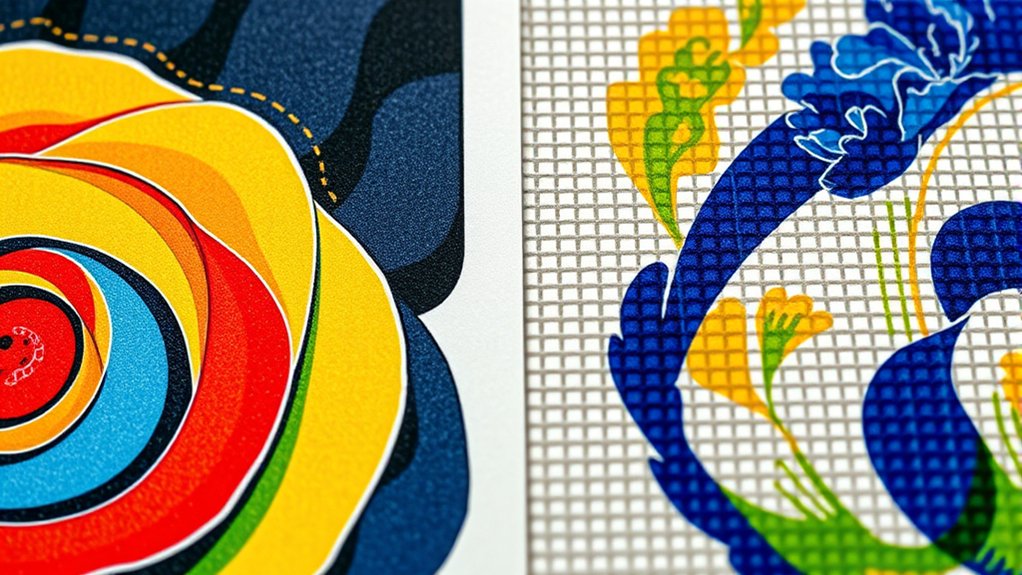

If you need precise color vibrancy and archival durability, serigraph gives you layered, pigment-based prints with superior detail on flat surfaces like paper and canvas.
Serigraph excels in premium tactile quality but costs more time and setup.
Screen printing, meanwhile, handles faster runs on flexible materials like textiles, using varied inks for broader commercial use.
Screen printing suits bulk jobs where speed matters and offers versatility in substrate choices.
Explore the differences in materials, quality, and cost to decide which fits your project best.
Understanding serigraph vs screen print will help you choose the ideal printing method for your needs.
Key Takeaways
- Serigraphy uses fine mesh and pigment-based inks for high-quality, archival art prints, while screen printing employs varied meshes and inks for broad commercial uses.
- Screen printing suits flexible textiles like apparel, whereas serigraphy excels on rigid, flat surfaces such as paper and canvas.
- Serigraph prints have superior ink longevity and tactile depth, offering better fade and abrasion resistance than typical screen prints.
- Screen printing allows faster, cost-effective large runs with lower setup costs but may require more labor for color separations.
- Choosing between methods depends on project needs: serigraphy for premium, detailed prints; screen printing for bulk, simpler designs.
What Is Serigraph Printing? How Does It Work?
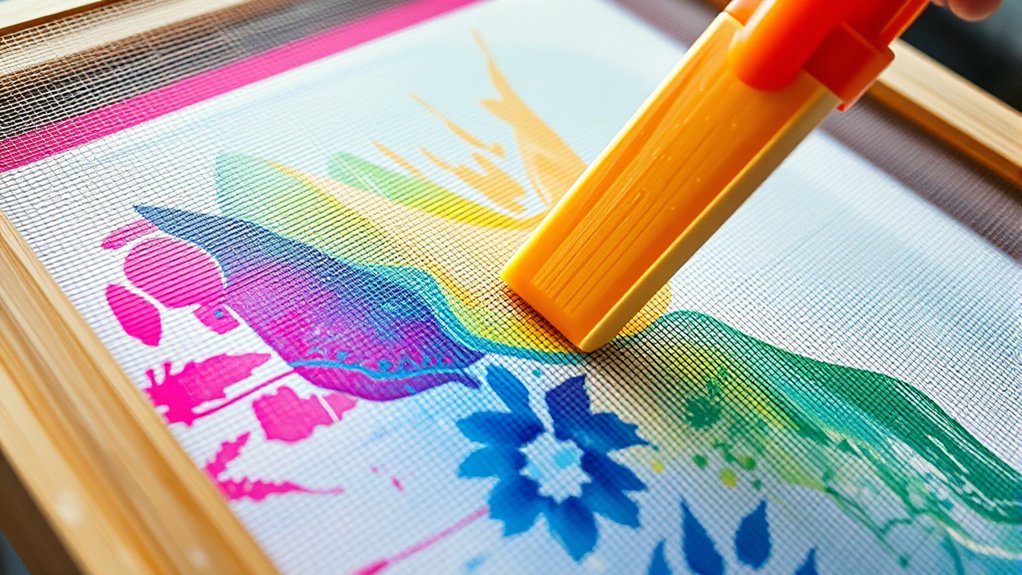
Serigraph printing, also known as silk screening, uses a fine mesh screen to transfer ink onto a substrate, except in areas blocked by a stencil. You prepare a stencil that defines the design, then stretch the mesh tightly over a frame.
When you apply ink and use a squeegee, it pushes ink through the open mesh areas onto the material beneath. This method allows precise control over ink placement, producing sharp, vibrant images.
Serigraphy excels as a print technique because it supports layering colors and textures, enhancing artistic expression. You can print on various surfaces, such as paper, fabric, or wood, making it versatile.
This approach emphasizes durability and richness in the final print, ideal for both fine art and commercial applications where detail and consistency matter.
How Does Screen Printing Compare to Serigraph?
You’ll notice screen printing and serigraphy share core techniques but differ in execution and materials used. Screen printing often handles thicker inks on varied surfaces, while serigraphy emphasizes fine detail with specific ink formulations.
Understanding their quality and durability will help you choose the best method for your project.
Definition And Techniques
Printing methods like screen printing and serigraphy rely on stencils and mesh screens to transfer ink onto surfaces, but they differ in application and detail. Screen printing uses a woven mesh to support an ink-blocking stencil, allowing ink to be pushed through open areas with a squeegee.
Serigraphy, rooted in artistic expression and printing history, emphasizes fine art prints, employing silk or synthetic mesh for precise, multi-layered color application. When you work with serigraphy, you’ll notice its focus on controlled ink deposition and crisp edges, ideal for detailed artworks.
Screen printing tends to accommodate broader commercial uses, handling varied materials and faster production. Understanding these techniques helps you appreciate how each method’s process shapes the final image’s texture and vibrancy, reflecting their distinct roles in printing history and creative practice.
Material And Ink Usage
Ink behavior and material compatibility play essential roles when comparing screen printing to serigraphy. In screen printing, you use a broader range of ink types, from plastisol to water-based, allowing versatility across substrates like textiles, plastics, and paper.
The ink’s viscosity and opacity adapt to the mesh tension and substrate porosity, ensuring sharp, opaque layers. Serigraphy, a fine art form of screen printing, typically employs high-quality, pigment-based inks designed for archival substrates such as cotton or fine papers.
This method demands precise ink formulation for ideal flow and saturation on delicate surfaces. While both techniques rely on stencil application through mesh screens, serigraphy emphasizes meticulous ink choice for enhanced substrate compatibility, resulting in vivid, stable prints.
When selecting your process, consider the ink types and their interaction with your substrate to achieve the desired visual effect and application efficiency.
Quality And Durability
Understanding how ink interacts with different materials sets the stage for evaluating the final output’s quality and durability. In serigraphy, the thick layers of ink applied through finely woven mesh create prints with superior ink longevity, resisting fading and cracking over time.
You’ll notice how the raised ink surface offers enhanced print resistance against abrasion and frequent washing. Screen printing, while versatile, often uses thinner ink layers, which may compromise durability under heavy wear.
However, advanced inks and curing techniques can improve its print resistance substantially. When you choose between the two, consider that serigraph’s quality excels in longevity and tactile depth, making it ideal for premium, long-lasting visuals.
Screen printing, meanwhile, balances durability with efficiency, suitable for high-volume runs where moderate ink longevity suffices.
Materials Used in Serigraph and Screen Printing
Both serigraph and screen printing rely on a mesh screen, but the materials you select for each process affect the final quality and detail of your print. You’ll find that ink types and fabric choices play significant roles. Serigraphy often uses finer mesh screens and higher-quality inks for sharper images.
Screen printing, on the other hand, accommodates a wider range of fabrics and ink viscosities, making it more versatile.
Consider these materials carefully:
Consider mesh screens, inks, fabrics, and emulsions carefully to achieve sharp, vibrant, and durable prints.
- Mesh screens: Nylon or polyester with varying mesh counts impact ink flow and detail.
- Ink types: Plastisol, water-based, or discharge inks alter texture and vibrancy.
- Fabric choices: Cotton, polyester, or blends influence ink absorption and print durability.
- Emulsion: Different emulsions affect stencil sharpness and longevity.
Selecting precise materials tailors your print’s visual impact and performance.
Which Method Offers Better Color and Detail Quality?
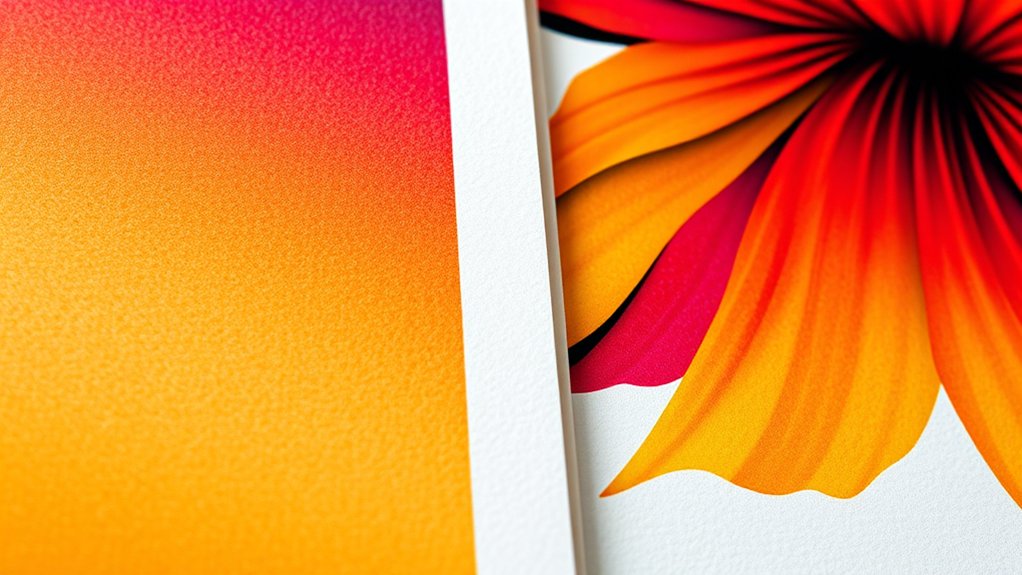
The choice of materials directly influences how vibrant and detailed your final print appears. Serigraphy uses finer mesh screens and hand-pulled inks, which allow for superior color vibrancy and sharper detail precision. This method enables subtle gradients and crisp edges, making it ideal when you want intricate designs with vivid hues.
Screen printing, while versatile, typically employs coarser meshes and automated presses, which can reduce fine detail and slightly dull color intensity. However, it excels in producing bold, solid colors quickly and consistently.
If your priority is maximum color vibrancy and intricate detail precision, serigraph offers a noticeable advantage. Conversely, screen printing suits projects where high volume and durability matter more than ultra-fine details or the richest color depth. Your choice hinges on these quality priorities.
Cost and Time Factors in Serigraph vs Screen Printing
You’ll face higher initial setup costs with serigraph due to detailed stencil preparation, while screen printing offers faster production speeds for large runs. Material and labor expenses vary, with serigraph demanding more hands-on time and specialized inks.
Understanding these factors helps you balance budget and turnaround needs effectively.
Initial Setup Costs
Although serigraph and screen printing share similarities, their initial setup costs differ considerably. When you evaluate the initial investment, serigraphy demands higher precision tools and finer mesh screens, increasing your setup requirements. Screen printing, while also requiring screens and frames, generally uses coarser materials, lowering upfront costs.
Key factors impacting your initial setup costs include:
- Quality and type of mesh screen
- Precision of stencil creation tools
- Equipment calibration for ink application
- Workspace preparation and lighting needs
Production Speed Differences
When comparing serigraph and screen printing, production speed plays a crucial role in cost and efficiency. Serigraph, known for its meticulous layering, generally demands longer drying times between colors, reducing production efficiency in large runs.
In contrast, screen printing employs faster ink application techniques, allowing you to complete high-volume jobs swiftly. The speed comparison reveals that screen printing is better suited for rapid turnaround, especially when dealing with multi-color designs.
However, if you prioritize detail over speed, serigraph’s slower pace might be acceptable. Understanding these differences helps you optimize workflow and meet deadlines effectively. Ultimately, your choice depends on balancing production efficiency with the quality requirements of your print project.
Material and Labor Expenses
Production speed directly influences material and labor costs in serigraph and screen printing. You’ll find that serigraph often requires higher initial material costs due to specialized inks and screens, but benefits from lower labor costs over large runs thanks to automation.
Screen printing, however, tends to have lower material costs but higher labor costs due to manual setup and adjustments. Consider these factors:
Serigraph’s durable screens increase upfront material costs but reduce waste.
Screen printing demands more hands-on labor for color separations and alignment.
Faster serigraph runs lower per-unit labor costs despite expensive materials.
Screen printing’s flexibility suits small batches but spikes labor costs.
Understanding these nuances helps you optimize your budget by balancing material costs with labor intensity per project.
Best Projects and Surfaces for Each Printing Method
Choosing the right printing method depends heavily on the project’s material and design complexity. For serigraph, you’ll find the best surfaces are rigid, flat materials like paper, canvas, and wood, where precise, multi-layered color work shines. It suits art prints, posters, and limited-edition designs demanding sharp detail and vibrant hues.
Screen printing, however, thrives on flexible textiles like cotton and polyester, making it ideal for apparel, banners, and promotional items. Its adaptability to various fabrics offers broader project suitability, especially for bulk runs. When deciding, consider if your project requires fine gradients or bold, solid colors on soft or hard surfaces.
Matching the printing method to your project’s substrate guarantees maximum ink adhesion, clarity, and overall visual impact.
Durability and Longevity of Serigraph and Screen Printing
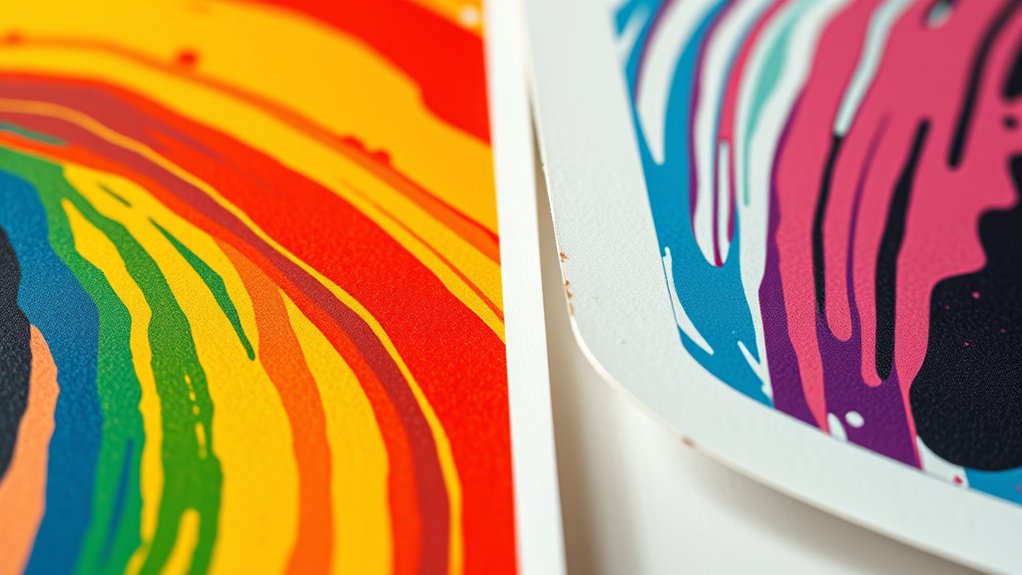
Durability defines how well serigraph and screen printing withstand wear, environmental factors, and time. When you compare their durability, serigraph excels with thicker ink layers, offering superior resistance to fading and cracking.
Screen printing, while efficient, often uses thinner inks that may degrade faster under harsh conditions. Key longevity factors include:
- Ink type and thickness affecting abrasion resistance
- Substrate compatibility influencing adhesion strength
- Exposure to UV light and moisture accelerating wear
- Curing process ensuring ink permanence and flexibility
How to Choose Between Serigraph and Screen Printing for Your Project
How do you determine which printing method suits your project best? Start by analyzing your project requirements and understanding your target audience. Serigraph excels in fine detail and color vibrancy, ideal for premium or limited editions. Screen printing works well for bulk orders with simpler designs.
| Criteria | Serigraph | Screen Printing |
|---|---|---|
| Detail Level | High | Moderate |
| Color Vibrancy | Excellent | Good |
| Order Size | Small to Medium | Medium to Large |
| Cost Efficiency | Higher per unit | Lower per unit |
| Audience Appeal | Art collectors, niche markets | Mass market, casual wear |
Match these factors to your project’s goals and target audience to choose the right method efficiently.
Frequently Asked Questions
Can Serigraph Printing Be Done at Home?
You can do serigraph printing at home with a proper home setup. Using DIY materials like mesh screens, photo emulsion, and squeegees, you’ll create detailed prints by pushing ink through stencils onto fabric or paper.
Is Screen Printing Eco-Friendly?
You’ll find screen printing sustainability improves with eco friendly inks, which reduce VOC emissions by up to 70%.
Using water-based inks and recycling screens, you actively minimize environmental impact in every print you create.
How Do Cleaning and Maintenance Differ for Each Method?
You’ll find cleaning techniques for serigraph require gentler solvents, while screen print demands thorough ink removal.
Maintenance frequency varies: serigraph needs less often, but screen prints require regular checks to avoid mesh clogging and color inconsistency.
Are There Health Risks Associated With Serigraph Inks?
Imagine handling vibrant inks. Health safety depends on ink composition. Some serigraph inks contain solvents or heavy metals, posing risks if inhaled or ingested.
Always wear gloves and guarantee proper ventilation to protect yourself effectively.
Can Both Methods Be Used for 3D Printing Effects?
You can achieve 3D effects with both printing techniques by layering ink or using specialized additives. However, screen printing offers more versatility for pronounced textures, while serigraph excels in fine, subtle dimensionality.
Conclusion
Choosing between serigraph and screen printing is like selecting the perfect lens for your project’s vision. Serigraph’s fine mesh captures intricate details with vivid color, while screen printing’s robust stencil delivers bold, durable impressions swiftly. Both methods layer inks like brushstrokes on canvas, yet differ in texture and time.
By weighing your surface, budget, and desired quality, you’ll focus your creative lens precisely. This careful consideration ensures your final print shines as intended, highlighting the unique strengths of serigraph versus screen print.