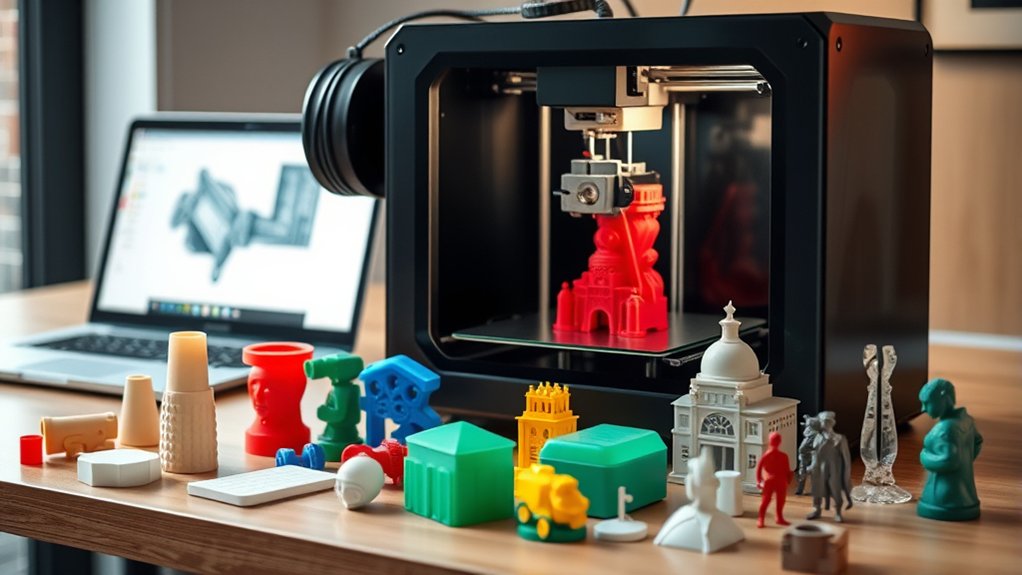

To make money with a 3D printer, focus on producing high-demand, customizable items like phone cases, replacement parts, or ergonomic tools.
Selling these products through platforms like Etsy, eBay, or specialized 3D print marketplaces can help you reach a broad audience.
Choose a printer that fits your target application—FDM for volume production or SLA for detailed work.
Price your products by considering material costs and print time, while keeping your prices competitive in the market.
Offering local custom printing services can help expand your client base and increase revenue.
Additionally, exploring workflow optimization techniques will boost your profitability as your 3D printing business grows.
Key Takeaways
- Identify trending, high-demand 3D printed products like custom phone cases and functional household gadgets to maximize sales potential.
- Sell products on platforms like Etsy, eBay, and specialized 3D print marketplaces for greater reach and customer diversity.
- Choose the right 3D printer technology (FDM, SLA, or SLS) based on product quality needs and cost efficiency.
- Set competitive pricing by analyzing production costs, market rates, and offering tiered pricing for complexity or volume.
- Scale operations with optimized workflows, automation, and targeted marketing to increase production capacity and attract premium clients.
Best-Selling 3D Printed Products to Make Money
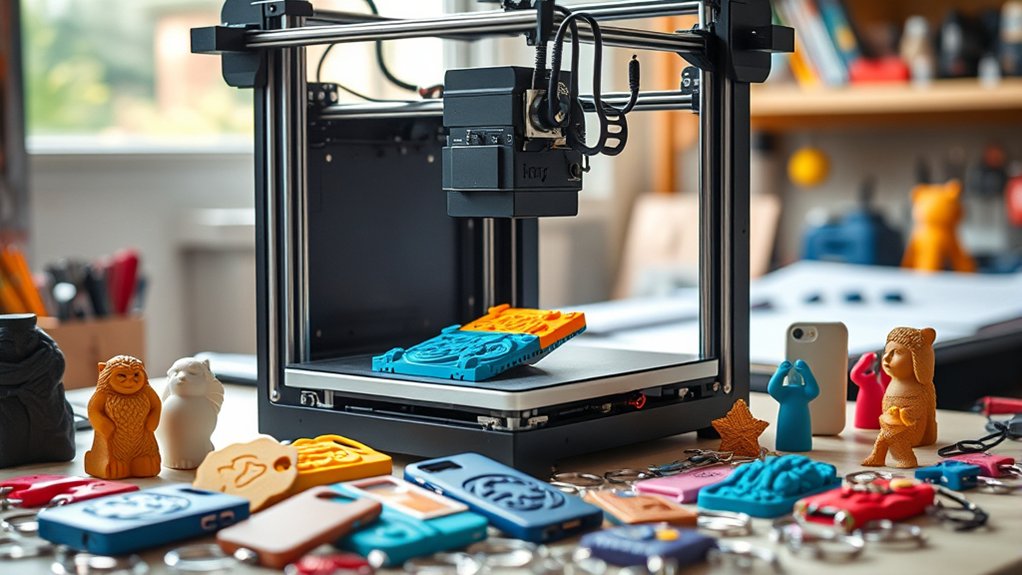
When looking to monetize your 3D printer, focusing on best-selling products can maximize your return on investment. Start by researching trending niche markets where demand outpaces supply.
Popular product ideas include customized phone cases, precision drone components, and ergonomic office accessories. These items benefit from rapid prototyping and personalization, which 3D printing excels at.
Additionally, consider functional household gadgets and replacement parts, as they often have high customer retention. Prioritize designs that balance complexity with print efficiency to reduce production time and material costs.
Constantly analyze market trends and customer feedback to refine your product lineup. By targeting a trending niche with well-researched product ideas, you enhance your competitive edge and profitability, ensuring your 3D printing venture scales sustainably.
Where to Sell Your 3D Prints Online and Locally
Where can you effectively market your 3D printed products to maximize sales and reach targeted customers? Leveraging both online marketplaces and local craft fairs provides a strategic balance between broad exposure and direct customer engagement.
Online marketplaces offer scalable platforms with built-in traffic, while local craft fairs enable personalized selling and brand building. Consider these key venues:
- Etsy and eBay for niche and mass-market 3D prints
- Specialized 3D print platforms like Shapeways or Cults3D
- Local craft fairs for immediate feedback and repeat business
- Makerspaces and community markets to connect with tech-savvy buyers
Utilize detailed product listings, professional photography, and targeted keywords to optimize online visibility. At local events, focus on demonstrating product functionality and engaging storytelling to drive conversions. Combining these approaches enhances your market reach and revenue potential.
Choose the Right 3D Printer for Maximum Profit
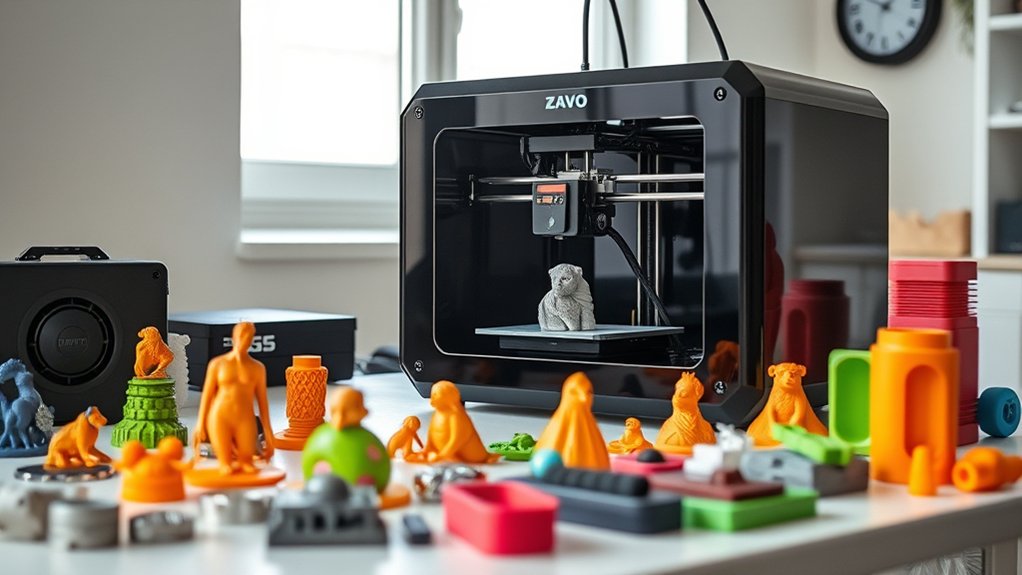
You need to evaluate printer types based on your target applications, balancing resolution, speed, and material compatibility. Consider the upfront investment against operational costs and print quality to guarantee your equipment supports scalable production.
Selecting the ideal 3D printer directly impacts your profit margins and market competitiveness.
Printer Types Comparison
Although selecting the ideal 3D printer may seem complex, understanding the key differences between FDM, SLA, and SLS technologies will help you maximize profitability. Each printer type varies in Printer Materials, Print Speed, Build Volume, Maintenance Costs, User Experience, and Print Quality, directly impacting your business.
FDM Printers offer low Maintenance Costs, larger Build Volume, and user-friendly operation but moderate Print Quality.
SLA (Resin) Printers excel in high Print Quality with fine details, ideal for intricate prototypes, though they require more maintenance.
SLS Printers provide robust mechanical parts with excellent Print Quality, using powdered materials; they support complex geometries but involve higher costs.
Consider your product requirements and volume demands carefully to select the printer type that aligns with your profitability goals.
Cost Versus Capabilities
Balancing cost against capabilities is essential when selecting a 3D printer to maximize your profit margins. You need to evaluate upfront investment relative to the printer’s technical specifications, build volume, and material selection flexibility.
Higher-end models often support advanced materials and tighter tolerances but come with increased maintenance costs and initial expense. Conversely, budget printers reduce capital outlay but may limit material compatibility or print quality, impacting product value.
Consider the frequency and cost of part replacements, calibration, and downtime in your operational expenses. Prioritize printers that align with your target market’s material demands and production scale while maintaining manageable maintenance costs.
This strategic approach guarantees your equipment delivers consistent output quality without inflating overhead, directly influencing your profitability.
Create Unique and Marketable 3D Designs
Since the value of 3D printing lies largely in innovation, developing unique and marketable designs is essential for generating consistent revenue. To excel, you must leverage design inspiration while rigorously analyzing market trends to identify gaps and demand.
Focus on creating prototypes that emphasize functionality, aesthetics, and manufacturability. Utilize CAD software to refine your models, ensuring precision and feasibility for production.
Consider these key strategies:
- Research emerging market trends to align your designs with current demand.
- Incorporate innovative features that differentiate your products from competitors.
- Test prototypes for durability and usability to increase customer satisfaction.
- Protect intellectual property through patents or copyrights to maintain exclusivity.
Price Your 3D Prints to Maximize Earnings
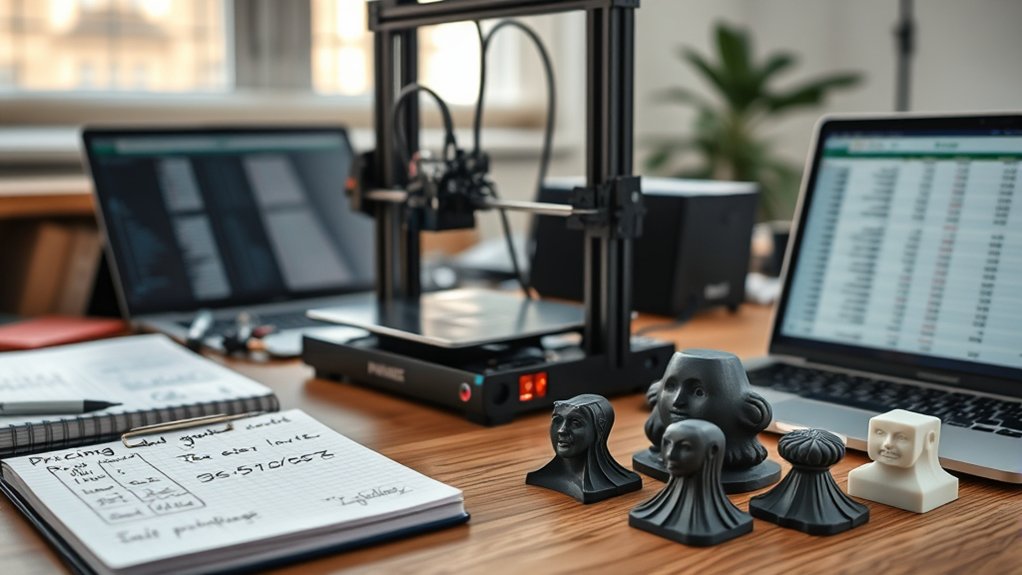
When determining how to price your 3D prints, you need to evaluate material costs, production time, and market demand to guarantee profitability. Start with a thorough cost analysis, including filament, electricity, machine depreciation, and labor. Factor in post-processing expenses and potential waste.
Your pricing strategy should balance covering these costs while remaining competitive within your niche. Analyze similar products’ prices to gauge market tolerance and adjust accordingly. Consider tiered pricing for complexity or volume discounts to optimize earnings.
Use precise data tracking to refine your cost inputs over time, ensuring your pricing remains accurate and sustainable. By leveraging a disciplined pricing strategy grounded in detailed cost analysis, you can maximize your margins and maintain a viable 3D printing business in a competitive marketplace.
Offer Custom 3D Printing Services Near You
Expanding your 3D printing business by offering custom services locally taps into growing demand for personalized manufacturing solutions. To succeed, focus on targeted local marketing strategies that position you as the go-to provider. Analyze service pricing carefully to remain competitive while covering material, labor, and machine depreciation costs.
Expanding locally with custom 3D printing meets demand and requires smart marketing and pricing strategies.
Key steps include:
- Identify niche markets requiring bespoke parts or prototypes.
- Utilize local SEO and social media to reach potential clients.
- Provide transparent, tiered service pricing based on complexity and turnaround time.
- Establish partnerships with local businesses needing rapid prototyping or small-run production.
How to Scale Your 3D Printing Side Hustle
To scale your 3D printing side hustle effectively, you need to optimize production workflows and invest in automation tools that increase output without sacrificing quality. Start by integrating batch printing and automated post-processing systems to reduce manual labor and turnaround time.
Implement robust marketing strategies, such as targeted social media campaigns and SEO-optimized online portfolios, to attract higher-value clients and expand your market reach. Utilize data analytics to monitor demand trends and adjust your production schedule accordingly.
Outsourcing non-core tasks, like design or finishing, can also help you focus on scaling core printing operations. By combining automation tools with strategic marketing initiatives, you’ll enhance efficiency, boost revenue, and position your side hustle for sustainable growth in the competitive 3D printing industry.
Frequently Asked Questions
What Materials Are Most Cost-Effective for 3D Printing?
You should focus on PLA alternatives like PETG or ABS after a thorough cost analysis. These materials balance durability and price, helping you optimize expenses while maintaining print quality. This balance is essential for professional 3D printing projects.
How Do I Maintain and Clean My 3D Printer?
You’d think your 3D printer’s nozzle could melt the sun if neglected! Prioritize printer maintenance by regularly cleaning nozzles with needles, wiping build plates, and lubricating rails. These precise cleaning techniques guarantee ideal print quality and machine longevity.
What Software Is Best for Beginners in 3D Design?
You should start with Tinkercad basics for intuitive, browser-based 3D modeling, then advance to Blender tutorials to master complex designs. Both offer industry-relevant tools, helping you build precise, professional-quality 3D assets efficiently.
Can 3D Printing Be Used for Prototyping Business Ideas?
Just like Da Vinci sketched inventions, you can leverage 3D printing’s advanced prototyping techniques to rapidly iterate designs. This precision accelerates product validation and enhances business applications, making your ideas tangible and market-ready efficiently.
What Are the Environmental Impacts of 3D Printing?
You’ll notice 3D printing reduces waste by using only necessary material, supporting sustainable practices. However, energy consumption and plastic filament disposal impact the environment.
Adopting recyclable materials and efficient workflows is essential for minimizing footprints.
Conclusion
By tapping into the $10.4 billion 3D printing market, you can turn your printer into a profitable asset. Focus on high-demand products, competitive pricing, and strategic sales channels to maximize returns. Custom services and scaling your operations will further boost your income.
Remember, choosing the right printer and unique designs directly impact your profit margins. With a clear plan and industry insight, you’re well-positioned to capitalize on this rapidly growing technology.
To truly succeed, integrate your skills and market knowledge to make money with a 3D printer effectively.