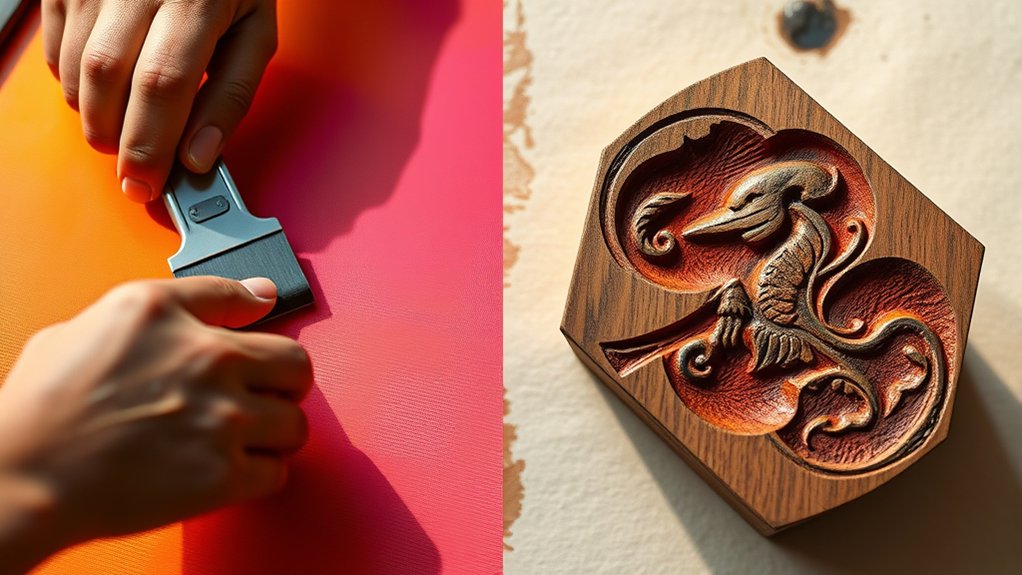

Screen printing vs printmaking offers distinct approaches to creating art, each with its unique advantages.
If you want bold, vibrant designs with sharp edges that can be replicated easily, screen printing is your go-to—it uses a mesh stencil to push ink through, ideal for fabric and commercial art.
But if you prefer unique, textured prints rich in subtle tones and artistic depth, printmaking techniques like etching or lithography create one-of-a-kind works.
Both have distinct tools and processes suited for different creative goals.
Keep exploring to understand which fits your project best.
Key Takeaways
- Screen printing uses mesh stencils and squeegees for bold, repeatable prints on fabric or paper, ideal for commercial and textile designs.
- Printmaking involves various techniques like etching and lithography, producing unique, textured, and nuanced works with artistic depth.
- Screen printing excels in vibrant colors and scalability but requires complex setup and durable materials.
- Printmaking allows limited editions with subtle variations but involves slower, more intricate processes.
- Choose screen printing for clarity and mass production; select printmaking for fine art and expressive, one-of-a-kind pieces.
What Is Screen Printing and How It Works
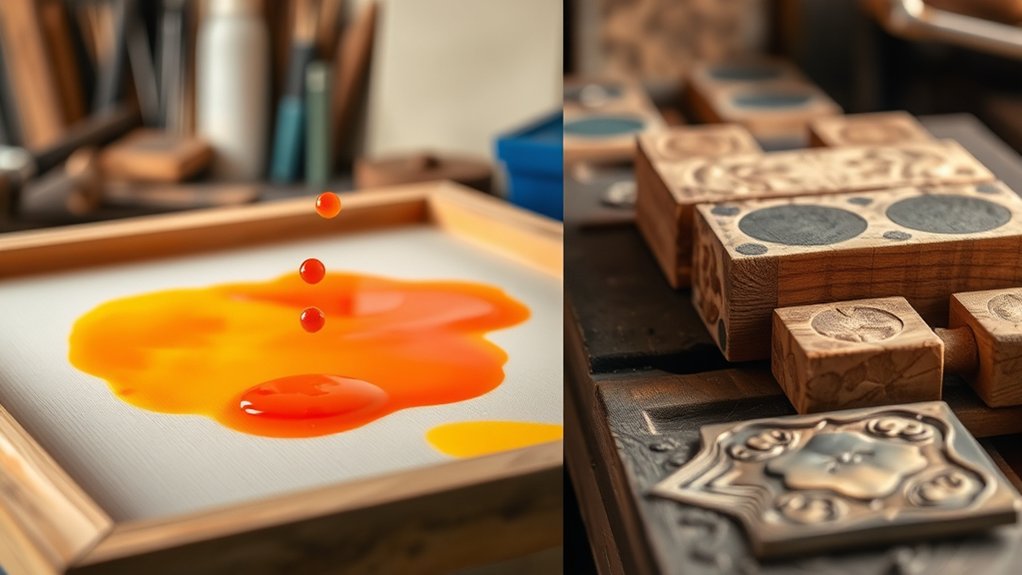
Screen printing uses a mesh screen to transfer ink onto a surface, except in areas blocked by a stencil. You start by preparing the screen with a fine mesh stretched tightly over a frame. Next, you apply a stencil that defines the design, blocking ink in specific areas.
During the screen printing process, you place the screen on the substrate, usually fabric, paper, or plastic. Then, you pull ink across the mesh with a squeegee. The ink passes through the open mesh areas, creating a sharp, vibrant print.
Understanding screen printing basics means grasping stencil creation, mesh tension, and ink viscosity. Each factor influences print quality, so you must control them precisely to achieve consistent, high-resolution results every time you print.
What Is Printmaking and How It’s Performed
Printmaking involves creating images by transferring ink from a prepared surface onto paper or other materials. You start by selecting a printmaking technique such as etching, lithography, woodcut, or relief printing, each requiring a distinct surface preparation.
In etching, you coat a metal plate with wax, carve your design, then immerse it in acid to etch grooves. Lithography uses a flat stone or metal plate treated to repel or attract ink. Once your matrix is ready, you apply ink, wipe off excess, then press paper onto the surface using a press or hand burnishing.
Understanding printmaking history reveals how these techniques evolved, connecting traditional craftsmanship with modern methods. By mastering these steps, you control texture, line quality, and tonal variation in your prints.
Main Differences Between Screen Printing and Printmaking
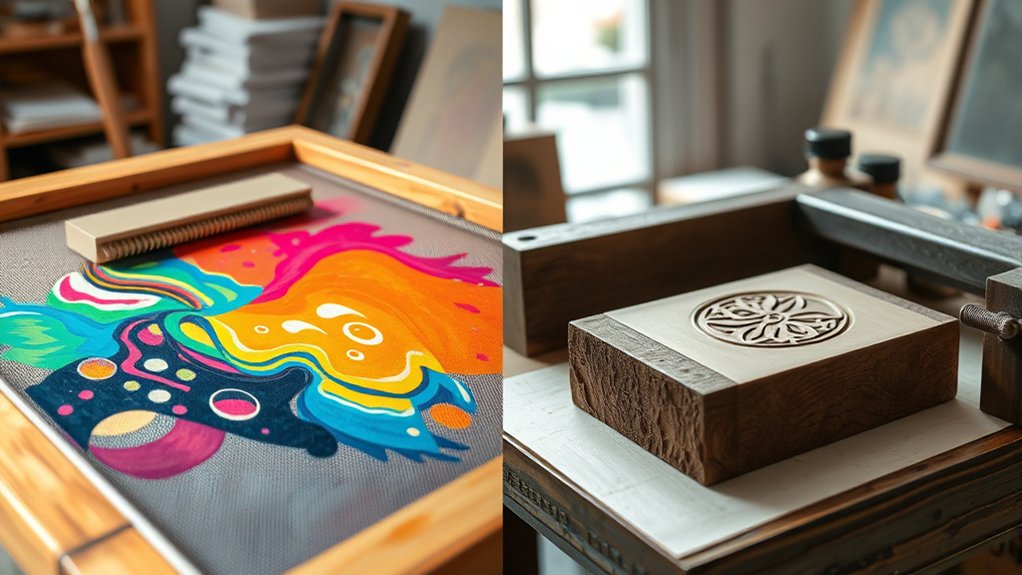
You’ll notice screen printing uses a mesh stencil and squeegee to push ink through, while printmaking involves various methods like etching or lithography with different tools and surfaces.
Each technique demands specific materials that affect texture, detail, and color layering. Understanding these differences helps you choose the right approach for your artistic goals.
Techniques and Materials
Although both methods involve transferring images onto surfaces, they rely on distinctly different techniques and materials. In your technique comparison, screen printing pushes ink through a fine mesh stencil directly onto fabric, paper, or other substrates, using squeegees for even application.
In contrast, printmaking encompasses diverse processes like etching, lithography, or woodcut that manipulate plates or blocks to imprint images onto paper. Material selection plays a vital role: screen printing demands durable mesh screens and plastisol or water-based inks suited for layering, while printmaking requires specialized plates (metal, stone, or wood), acid baths, and various inks tailored to each technique.
Understanding these technical distinctions guarantees you choose the best method and materials for your project, optimizing image clarity, texture, and durability.
Artistic Applications
When exploring artistic applications, screen printing excels in producing bold, vibrant designs with sharp edges, making it ideal for commercial art and textile decoration. You can easily layer colors and replicate consistent images across multiple surfaces, enhancing graphic clarity and visual impact.
In contrast, printmaking embraces diverse artistic styles, from etching to lithography, allowing you to experiment with texture, tone, and subtle gradations. This medium supports more nuanced creative expression, often yielding unique, one-of-a-kind prints rather than mass-produced copies.
While screen printing favors precision and repeatability, printmaking invites you to explore spontaneity and variation. Understanding these distinctions helps you choose the best technique to match your artistic vision, whether you seek bold uniformity or intricate, textural depth.
Materials and Tools for Screen Printing and Printmaking
Tools shape the quality and style of both screen printing and printmaking. In screen printing, you’ll work with specific ink types like plastisol or water-based inks, each offering unique finishes. Mesh counts on your screens vary; finer meshes produce detailed images, while lower counts allow bolder coverage.
You’ll also need squeegees, emulsions, and frames tailored to your design’s complexity. Printmaking relies on diverse tools depending on the technique. Etching requires plates, needles, and acid baths; relief printing uses carving tools and blocks.
Ink types differ too, often oil-based or water-soluble, matching your press and paper. Both methods demand precision tools that influence texture, line quality, and durability. Choosing the right materials guarantees your prints convey your vision sharply and professionally.
Best Artwork Types for Screen Printing and Printmaking

What types of artwork suit screen printing and printmaking best? For screen printing, bold, graphic images like abstract designs and textile patterns excel. The technique’s sharp edges and vibrant colors highlight repetitive motifs and geometric shapes, making it ideal for fabric and poster production.
In contrast, printmaking accommodates intricate line work and subtle tonal variations, perfect for detailed sketches or expressive etchings. You’ll find relief prints and lithographs excel with fine textures and gradations, capturing depth and nuance.
While screen printing thrives on flat, layered color fields, printmaking embraces complexity and subtlety. Choosing between them depends on your artwork’s style: use screen printing for striking, colorful textile patterns and printmaking for nuanced, detailed images with rich textures and shading.
Screen printing suits bold, colorful patterns, while printmaking captures detailed, textured, and nuanced imagery.
Both techniques offer distinct visual strengths tailored to different artistic goals.
Screen Printing vs Printmaking: Pros and Cons
Understanding the ideal artwork for screen printing and printmaking sets the stage for evaluating their practical advantages and drawbacks. Screen printing offers vibrant colors and sharp edges, making it perfect for bold, graphic designs.
Its pros include speed and scalability, but the cons involve setup complexity and limited fine detail. Printmaking excels in texture and subtle gradients, giving your work a handcrafted feel.
The advantages lie in artistic depth and variety of techniques, while the disadvantages include slower production and less consistency across prints. You’ll find screen printing suits commercial projects with repetitive demands, whereas printmaking works best for unique, expressive pieces.
How History Shaped Screen Printing and Printmaking
Although screen printing and printmaking share the goal of transferring images onto surfaces, their historical paths have shaped distinct techniques and applications. You’ll notice that historical influences deeply impact how each method evolved and their cultural significance today.
Screen printing emerged from ancient stencil traditions, later refined for commercial use. Printmaking, rooted in woodcuts and etching, developed within fine art contexts.
Key historical influences include:
- Ancient Asian stencils inspiring screen mesh use
- Renaissance printmakers advancing etching and engraving
- Industrial Revolution boosting screen printing’s mass production
- Printmaking’s role in political and cultural expression
These legacies guide you in understanding each method’s technical rigor and artistic value, helping you appreciate their unique contributions to visual culture.
Choosing Screen Printing or Printmaking for Your Project
The unique histories of screen printing and printmaking inform how you choose the right method for your project. Screen printing excels when your project goals demand bold, vibrant colors and sharp edges on various surfaces. Its stencil-based process suits graphic, modern artistic styles and commercial applications.
Printmaking, with techniques like etching or lithography, offers intricate textures and tonal depth, fitting projects that emphasize fine detail and traditional artistic style. Consider your desired output: screen printing provides repeatability and durability, ideal for multiple copies or wearable art.
Printmaking yields limited editions with subtle variations, enhancing uniqueness. Match your project goals to each method’s strengths. Choose screen printing for clarity and scalability or printmaking for complexity and artistic nuance, ensuring your final piece reflects both technique and vision efficiently.
Frequently Asked Questions
Can Screen Printing Be Combined With Digital Printing Techniques?
You can combine screen printing with digital printing techniques using digital integration and hybrid techniques. This approach lets you layer vibrant screen prints over precise digital images, creating detailed, textured results with enhanced visual depth and technical control.
What Environmental Impacts Do Screen Printing and Printmaking Have?
You generate chemical waste, use water intensely, and handle inks carefully. You mitigate impacts by adopting sustainable practices, improving waste management, and selecting eco-friendly materials.
Both processes demand vigilance to minimize their environmental footprint effectively.
How Do Drying Times Compare Between Screen Printing and Printmaking?
You’ll find screen printing dries faster due to plastisol inks and heat drying techniques, while printmaking, using water-based or oil inks, requires longer air-drying or chemical drying methods. This difference impacts overall project timing considerably.
Are There Any Health Risks Associated With Materials Used in Both Methods?
Better safe than sorry: you’ll face health concerns with solvents, inks, and acids in both methods. Use gloves, masks, and proper ventilation as safety precautions to protect your lungs and skin during your creative process.
Can Beginners Easily Learn Screen Printing Compared to Printmaking?
You’ll find beginner techniques in screen printing more accessible, letting you quickly grasp basics like stencil creation and ink application. This hands-on approach accelerates skill development compared to the intricate, layered processes printmaking demands.
Conclusion
Choosing between screen printing and printmaking is like picking between a camera and a paintbrush—each shapes your vision uniquely.
Remember when Andy Warhol turned simple screen prints into iconic art, proving how technique fuels creativity? Whether you crave crisp, repeatable designs or rich, textured originals, knowing their tools and processes lets you craft with precision.
So, trust your project’s needs to guide you, and watch your ideas come alive with vivid clarity in screen printing vs printmaking.