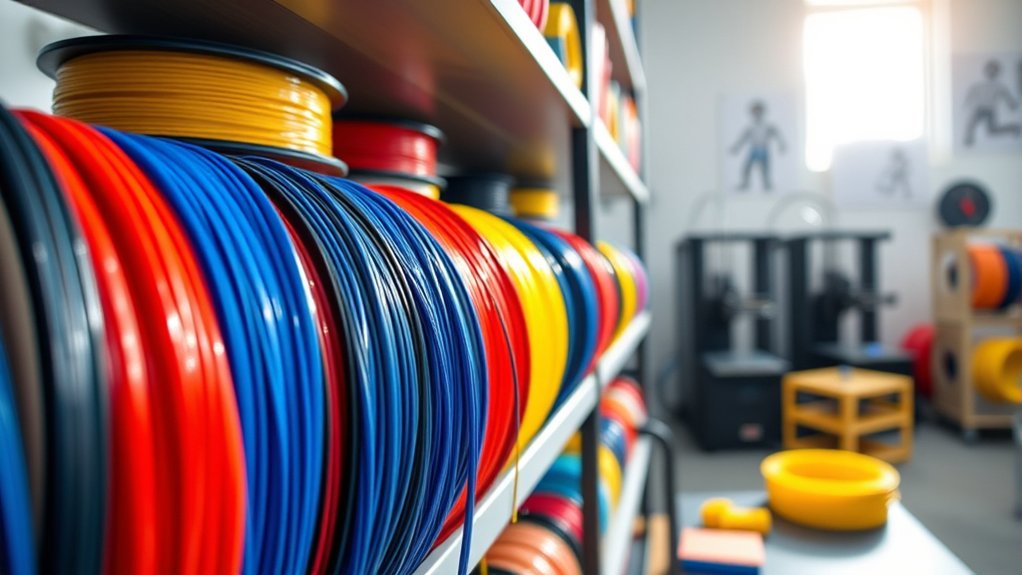

You can buy 3D printer filament from reputable online retailers like MatterHackers and Prusa Research, which offer extensive selections including specialty materials.
Local shops and makerspaces provide immediate access to standard filaments like PLA and ABS.
Specialty stores supply advanced options such as carbon fiber or TPU for specific project needs.
Consider subscription services or bulk buying to save costs and guarantee steady supply.
Explore quality indicators and pricing strategies to optimize your filament purchase.
Key Takeaways
- Purchase filaments from trusted online retailers like MatterHackers, Prusa Research, Amazon, and FilamentOne for quality and variety.
- Specialty filament stores offer advanced materials such as carbon fiber, TPU, metal-filled, and wood-filled options for specific applications.
- Local shops and makerspaces provide immediate access to common filaments like PLA, ABS, and PETG for quick purchases and quality inspection.
- Evaluate filament quality by confirming diameter tolerance, packaging, brand reputation, and customer reviews before buying.
- Consider subscription services or bulk buying for cost savings, consistent supply, and convenience based on your printing needs.
How To Choose The Right 3D Printer Filament For Your Project
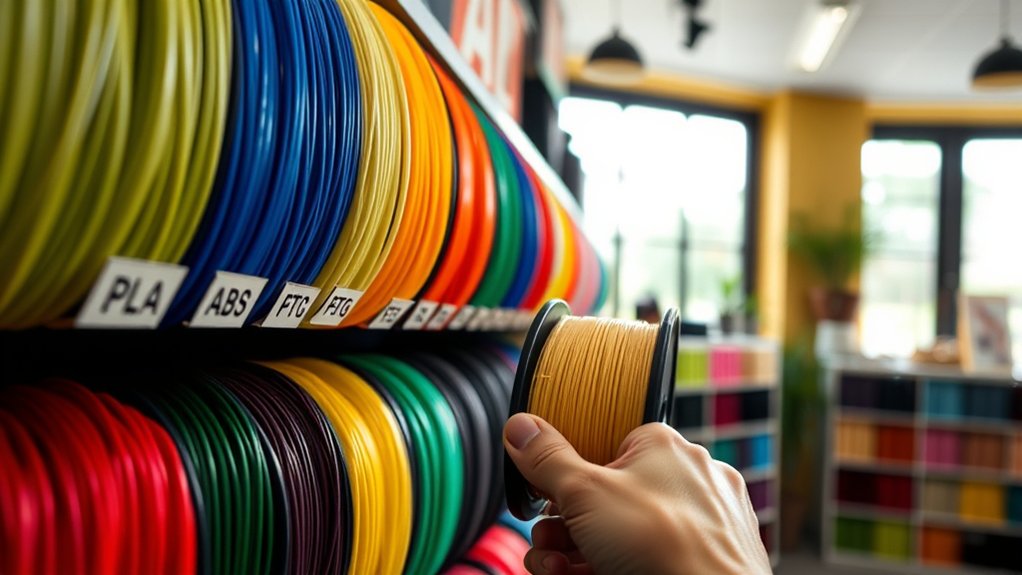
When selecting 3D printer filament for your project, you need to contemplate factors like material properties, printer compatibility, and intended application. First, verify filament compatibility with your printer’s specifications, including diameter tolerance and extrusion temperature.
Next, assess project requirements such as mechanical strength, flexibility, or heat resistance to determine the ideal material. PLA offers ease of use, while ABS or PETG provide enhanced durability. Consider environmental conditions and post-processing needs to guarantee the filament meets performance criteria.
Additionally, evaluate filament color, finish, and potential for warping or shrinkage during printing. By aligning filament compatibility with precise project requirements, you’ll enhance print quality and functionality, avoiding material-related failures and improving your final output’s structural integrity and aesthetic appeal.
Best Places To Buy 3D Printer Filament Online
You can find high-quality 3D printer filament from top online retailers that offer a wide range of brands and materials. Specialty filament stores provide advanced options tailored for specific printing needs, such as flexible or composite filaments.
Choosing the right source depends on your project requirements and desired filament properties.
Top Online Retailers
Although 3D printer filament is available from numerous sources, choosing the right online retailer guarantees consistent quality, competitive pricing, and reliable shipping. When exploring top online retailers, you’ll find industry leaders like MatterHackers and Prusa Research, which stay aligned with evolving 3d printing trends and filament innovations.
These platforms offer extensive selections of PLA, ABS, PETG, and specialty blends, ensuring compatibility with diverse printers and projects. Their rigorous quality controls minimize filament inconsistencies that can compromise print precision.
Additionally, retailers such as Amazon and FilamentOne provide user reviews and bulk options, allowing you to evaluate performance and optimize costs effectively. By prioritizing trusted online sources, you secure access to cutting-edge materials and streamlined purchasing, enhancing your 3D printing experience with dependable filament deliveries.
Specialty Filament Stores
Since standard filaments might not meet every specialized printing need, specialty filament stores offer advanced materials designed for particular applications. When you seek specialty filament types like carbon fiber-infused, metal-filled, or flexible TPU variants, these stores provide precisely engineered options to match your unique filament applications.
They cater to industries requiring enhanced mechanical strength, heat resistance, or electrical conductivity. By sourcing from specialty filament stores, you gain access to detailed specifications, ensuring compatibility with your printer and project requirements.
These suppliers often provide technical datasheets, helping you optimize print settings for peak performance. Whether you need filaments for aerospace prototypes, medical models, or artistic endeavors, specialty filament stores deliver the materials necessary to push your 3D printing beyond conventional limits.
Local Shops And Makerspaces That Sell 3D Printer Filament

When seeking 3D printer filament, local shops and makerspaces offer immediate access to a variety of materials without the wait of shipping. These local retailers and community workshops typically stock standard filaments like PLA and ABS, enabling quick purchases to keep your projects on schedule.
Visiting them also lets you inspect filament quality firsthand. Consider these common offerings:
- PLA spools in various colors, ideal for prototypes and educational projects
- ABS filament suited for durable, heat-resistant parts
- PETG for strong, flexible models with chemical resistance
- Specialty blends that local makerspaces experiment with, providing unique options
Specialty 3D Printer Filaments: TPU, Carbon Fiber, And More
You’ll find specialty filaments like TPU, known for its flexibility, and carbon fiber composites, prized for strength and stiffness. These materials offer unique mechanical properties that standard PLA or ABS can’t match.
To get the best quality, source them from reputable manufacturers specializing in advanced 3D printing materials.
Types Of Specialty Filaments
Although standard filaments like PLA and ABS cover most 3D printing needs, specialty filaments offer unique properties that expand your project’s capabilities. These filaments cater to specific technical demands and environmental considerations, allowing you to customize strength, flexibility, or aesthetic effects.
Here are four common types of specialty filaments:
- TPU (Thermoplastic Polyurethane) is flexible, durable, and impact-resistant, ideal for wearables and prototypes needing elasticity.
- Carbon fiber infused filaments are lightweight with enhanced rigidity and heat resistance, perfect for structural parts.
- Wood-filled filaments combine PLA with wood particles, offering a natural finish and biodegradable benefits.
- Metal-filled filaments contain fine metal powders, providing weight and metallic sheen for decorative or functional objects.
Each specialty filament’s unique properties make them suitable for niche applications beyond standard materials.
Benefits Of TPU And Carbon Fiber
Specialty filaments like TPU and carbon fiber enhance your 3D printing projects by offering distinct mechanical advantages. TPU advantages include flexibility, abrasion resistance, and impact absorption, making it ideal for wearable items and functional prototypes.
Carbon fiber applications focus on rigidity and strength, lending lightweight durability to automotive parts and drone components. Understanding these benefits helps you select the right filament for your needs.
| Filament Type | Key Benefits |
|---|---|
| TPU | Flexibility, impact resistance |
| Carbon Fiber | High strength, lightweight |
| TPU | Abrasion resistance, elasticity |
| Carbon Fiber | Dimensional stability, durability |
Choose TPU when you need elasticity; opt for carbon fiber for structural reinforcement and enhanced mechanical performance.
Where To Source Specialty Filaments
Finding reliable sources for TPU, carbon fiber, and other specialty 3D printer filaments can greatly impact the quality and performance of your prints. To guarantee peak results, you need effective sourcing techniques and trusted specialty suppliers. Here’s where to look:
1. Manufacturer Direct
Buy directly from filament producers for authentic material specs and batch consistency.
2. Specialty Suppliers
Seek out vendors specializing in advanced filaments; they often provide detailed datasheets and support.
3. Industrial Distributors
These offer bulk options and certifications suitable for professional applications.
4. Online Marketplaces
Use caution, but verified sellers on platforms like Amazon or MatterHackers can provide variety and user reviews.
Comparing 3D Printer Filament Prices: Finding The Best Deals
When you compare 3D printer filament prices, you’ll notice significant variations depending on the brand, material type, and spool size. To find the best deals, focus on the cost per gram or kilogram rather than the overall spool price.
Keep in mind that specialty filament colors and filament textures often command higher prices due to manufacturing complexity. You should also consider the filament’s diameter tolerance and compatibility with your printer to avoid costly print failures.
Bulk purchases can reduce the unit price, but only if you’re confident in the filament’s quality and your usage rate. Don’t overlook reputable manufacturers offering consistent filament properties; cheaper alternatives may save money upfront but increase waste.
Comparing prices across multiple suppliers while factoring in shipping costs will help you maximize value without compromising print quality.
Subscription Services For Regular 3D Printer Filament Delivery
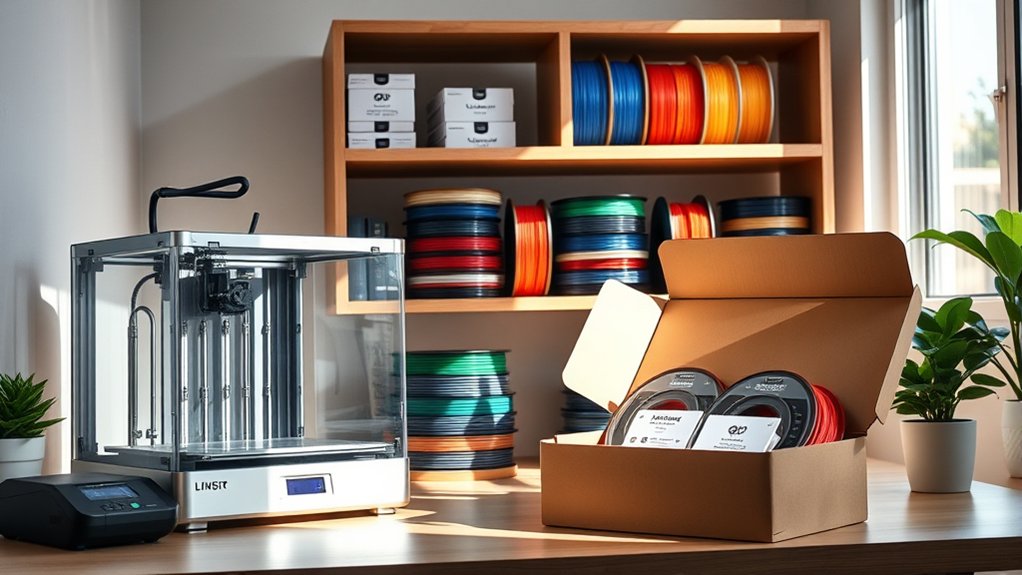
After evaluating filament prices and quality, you might consider subscription services to streamline your supply of 3D printer filament. Subscription benefits include consistent availability, cost savings, and reduced ordering effort.
These services tailor delivery options to your usage patterns, ensuring you never run out mid-project. When choosing a subscription, focus on:
- Filament variety offered, matching your preferred materials and colors.
- Frequency flexibility, allowing adjustments based on your printing volume.
- Pricing models, including discounts for longer commitments.
- Shipping reliability and packaging quality to protect filament integrity.
Buying 3D Printer Filament In Bulk: Pros, Cons, And Trusted Suppliers
Although buying 3D printer filament in bulk requires a larger initial investment, it offers significant cost savings and guarantees a steady supply for high-volume printing. Taking advantage of bulk pricing reduces your per-kilogram cost, but you must evaluate supplier reputation to avoid quality issues. Trusted suppliers assure consistent filament diameter and material properties, essential for print reliability.
| Pros | Cons | Considerations |
|---|---|---|
| Lower cost per unit | Higher upfront cost | Verify supplier reviews |
| Continuous filament flow | Storage space needed | Confirm material specs |
| Reduced order frequency | Risk of outdated stock | Check return policies |
Carefully choose reputable suppliers to maximize bulk purchase benefits without compromising print quality.
How To Spot Good-Quality 3D Printer Filament Before You Buy
Securing a reliable supplier for bulk filament is only part of the equation; guaranteeing the filament’s quality before purchase safeguards your prints and equipment. To spot good-quality 3D printer filament, consider these key factors:
- Brand reputation: Choose manufacturers known for consistent quality and positive user feedback.
- Filament color consistency: Inspect samples to verify uniform color throughout the spool, indicating proper pigment dispersion.
- Diameter tolerance: Confirm the filament maintains a strict ±0.05 mm diameter tolerance to guarantee smooth extrusion and dimensional accuracy.
- Packaging and storage: Look for vacuum-sealed, moisture-resistant packaging to prevent filament degradation.
Frequently Asked Questions
How Should I Store 3D Printer Filament to Prevent Damage?
You should follow filament storage tips like keeping it in airtight containers with desiccants, avoiding humidity exposure. Maintain stable temperature considerations between 15-25°C to prevent warping or brittleness, ensuring consistent print quality and filament longevity.
Can I Use Expired 3D Printer Filament Safely?
Expired filament is like faded ink. It’s still usable but less reliable. You can use it, but watch for brittleness or poor adhesion.
Prioritize 3D printing safety by testing small prints and ensuring consistent extrusion before major projects.
What Are Common Signs of Filament Moisture Issues?
You’ll notice filament degradation signs like brittle texture, popping sounds during printing, and poor layer adhesion. These occur because moisture absorption causes steam pockets, leading to inconsistent extrusion and weakened final print quality.
How Do Different Filament Colors Affect Print Quality?
Different filament colors can cause color variation, impacting print consistency due to varying pigment additives.
You’ll notice slight changes in melting temperature and flow, so adjusting print settings guarantees ideal quality across colors for consistent results.
Are There Eco-Friendly Options for 3D Printer Filament Disposal?
You won’t believe how compostable materials revolutionize filament disposal! You can choose biodegradable options like PLA, which break down naturally, letting you responsibly recycle your prints without harming the environment or complicating waste management processes.
Conclusion
Now that you know where to find quality 3D printer filament and how to choose the right type for your project, the real challenge begins: selecting the perfect filament that balances price, performance, and specialty needs.
Will you go for bulk buying, subscription services, or that local gem? The ideal filament is out there—waiting for you to access your printer’s full potential.
Choose wisely, because your next print depends on it. Knowing where to buy 3D printer filament can make all the difference in achieving outstanding print results.