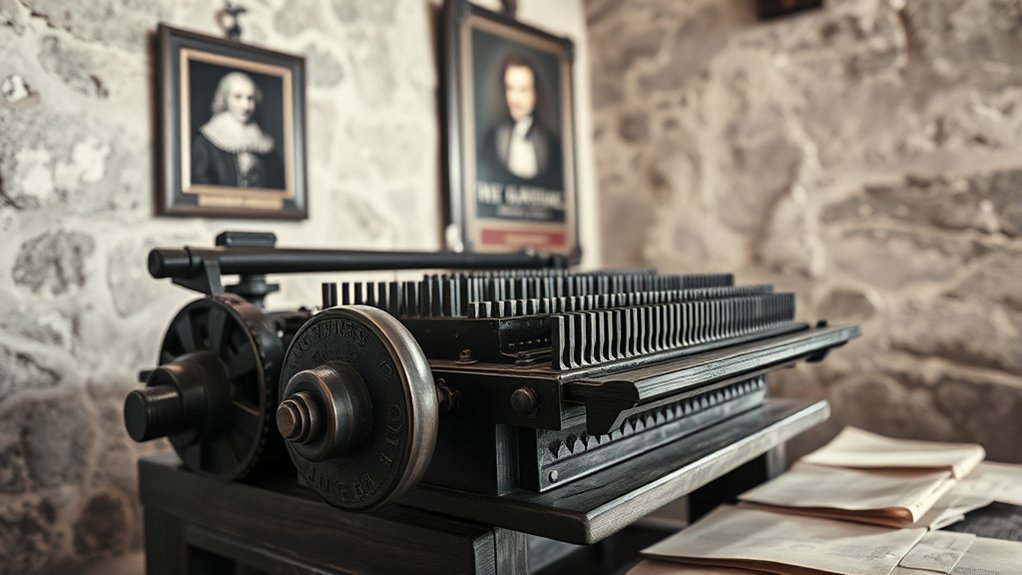

You can credit Johannes Gutenberg with inventing the first practical printer machine around 1440, introducing movable type that transformed how information spreads. The invention of the printer machine marked a significant leap in communication and knowledge dissemination.
Early printers evolved from his design, improving speed and print quality through mechanization. Innovators like Chester Carlson and Gary Starkweather further shaped modern printers by developing xerography and laser printing.
Meanwhile, Canon advanced inkjet technology, expanding the capabilities of printer machines.
Understanding these developments reveals how printer technology remains essential and continuously evolves to meet today’s needs. The journey from Gutenberg’s press to modern printers highlights the ongoing innovation in this field.
Key Takeaways
- Johannes Gutenberg invented the first printing press with movable type around 1440.
- Chester Carlson developed xerography, the foundation for modern laser printing technology.
- Gary Starkweather adapted xerography into laser printing, enhancing speed and precision.
- Ichiro Endo of Canon pioneered inkjet technology for affordable color printing.
- IBM developed dot matrix printers for mechanical impact printing in early computer output.
Who Invented the First Printer Machine and When?
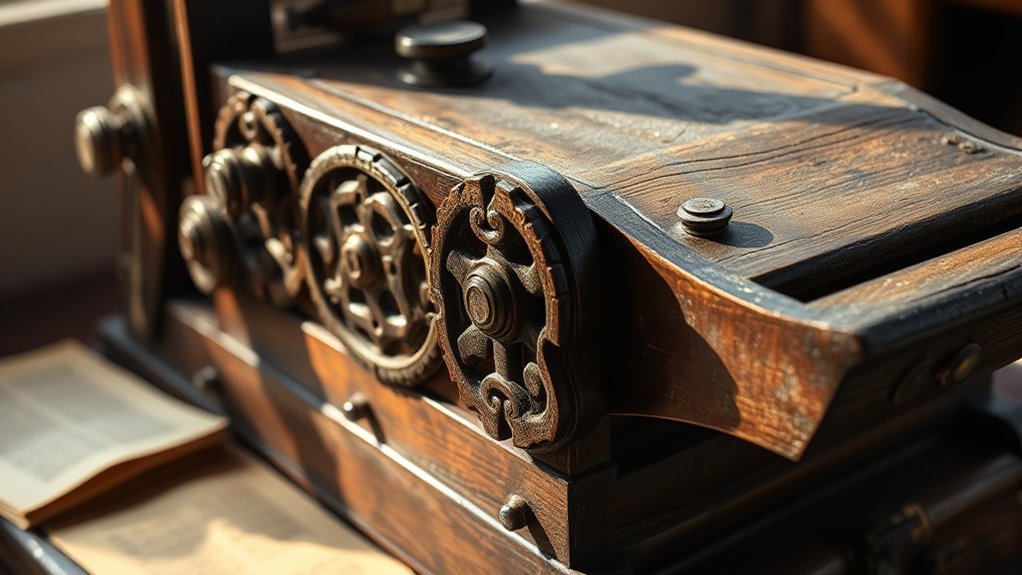
The invention of the first printer machine marks a pivotal moment in technological history, fundamentally transforming how information is reproduced and disseminated. You should know that Johannes Gutenberg is credited with inventing the printing press around 1440.
This invention introduced movable type, allowing for mass production of texts previously copied by hand. The printing press’s historical impact cannot be overstated; it accelerated the spread of knowledge, literacy, and ideas across Europe. By mechanizing reproduction, it challenged established communication methods and facilitated the Renaissance, Reformation, and Scientific Revolution.
Understanding who invented the first printer machine and when provides insight into how this technology reshaped society. You can see that Gutenberg’s printing press laid the groundwork for all future developments in printing technology.
How Early Printers Changed Printing Technology
Although early printers built upon Gutenberg’s foundational design, they introduced significant innovations that enhanced speed, efficiency, and accessibility in printing technology. You’ll notice that these advances refined traditional printing techniques by mechanizing processes, allowing for quicker reproduction of texts and images.
This mechanization reduced manual labor and errors, setting the stage for mass communication. Additionally, early printers improved ink application methods and paper handling, which increased print quality and durability.
These developments laid the groundwork for future technologies, including digital printing, by demonstrating the importance of precision and automation. By understanding how these early innovations transformed printing, you can appreciate the technological evolution that eventually shifted from manual presses to sophisticated digital systems, revolutionizing information dissemination worldwide.
Key Inventors Who Shaped Modern Printer Machine Innovations
Three key inventors revolutionized printer machine technology by introducing breakthroughs that transformed printing from mechanical to digital processes. Chester Carlson developed xerography, the foundation for laser printing, enabling faster, high-quality text reproduction.
His innovation paved the way for Gary Starkweather, who adapted xerography into laser printing, greatly enhancing speed and precision in office environments. Meanwhile, Canon’s Ichiro Endo innovated inkjet technology by creating a method of ejecting tiny ink droplets, allowing affordable color printing with fine detail.
These inventors addressed distinct technical challenges: Carlson with static charge imaging, Starkweather with laser modulation, and Endo with microfluidics. Each contributed critical components to digital printing. Understanding their work helps you appreciate how modern printers evolved into versatile, efficient machines integral to personal and professional use worldwide.
Major Printer Machine Types and Their Inventors
When you explore the evolution of printer machines, you’ll find distinct types each pioneered by innovators who addressed unique printing needs. Early impact printers, like the dot matrix, were developed by IBM, enabling mechanical imprinting on paper.
The rise of inkjet technology, credited to Canon and Hewlett-Packard, revolutionized home and office printing with precise ink droplet control. Meanwhile, laser advancements by Gary Starkweather at Xerox introduced high-speed, high-quality printing through electrostatic processes.
| Printer Type | Key Inventor(s) |
|---|---|
| Dot Matrix | IBM |
| Inkjet Technology | Canon, Hewlett-Packard |
| Laser Printer | Gary Starkweather (Xerox) |
Each type reflects innovation tailored to different demands, shaping how you print today.
Why Is the Printer Machine Still Essential Today?
Even as digital documents dominate many aspects of communication, printer machines remain essential tools in various contexts. You rely on printers for physical copies that digital documentation can’t fully replace, such as legal contracts, official forms, or educational materials.
Printers also support tasks requiring high-resolution color accuracy, like graphic design proofs and marketing materials. Additionally, the concept of printing sustainability has advanced, making modern printers more eco-friendly through reduced ink consumption and recyclable components.
These improvements address environmental concerns while preserving the convenience and reliability of printed media. As a result, despite the rise of digital alternatives, printer machines continue to offer indispensable benefits in accuracy, tangibility, and sustainability, justifying their ongoing relevance in both professional and personal settings.
Frequently Asked Questions
How Does a 3D Printer Differ From Traditional Printers?
You’ll see 3D printers use 3D technology and additive manufacturing, building objects layer by layer, unlike traditional printers that apply ink on paper.
This method lets you create complex, physical items, not just images or text.
What Materials Can Modern Printers Use Besides Paper?
You can print on fabrics, plastics, metals, and even wood with modern printers. Many now support eco friendly materials, reducing environmental impact while enabling diverse applications like fabric printing and sustainable packaging solutions.
How Do Printers Connect to Computers and Devices?
Like a bridge linking two islands, printers connect to your devices via USB connections or wireless printing. USB offers direct, stable links, while wireless lets you print from anywhere, ensuring flexibility and convenience in your workflow.
What Are the Environmental Impacts of Printer Ink and Paper?
You should know ink production releases harmful chemicals, impacting air and water quality. Paper recycling reduces deforestation and waste, but improper disposal still strains ecosystems.
Balancing ink use and recycling helps minimize printers’ environmental footprint effectively.
Can Printers Print in Multiple Colors Simultaneously?
You’ll find that 85% of modern printers support color printing with simultaneous output, allowing multiple colors to print at once. This boosts efficiency and guarantees accurate color reproduction in complex images or documents.
Conclusion
You’ve seen how early inventors like Johannes Gutenberg revolutionized printing, laying the groundwork for today’s advanced machines.
Imagine a small business owner using a modern inkjet printer to produce high-quality marketing materials quickly and affordably—this shows why printers remain essential.
Despite digital trends, printers continue adapting, proving their lasting relevance. Understanding their history helps you appreciate how these machines still shape communication and productivity in your daily life.
The invention of the printer machine has had a profound impact, making it a cornerstone of modern technology and everyday use.