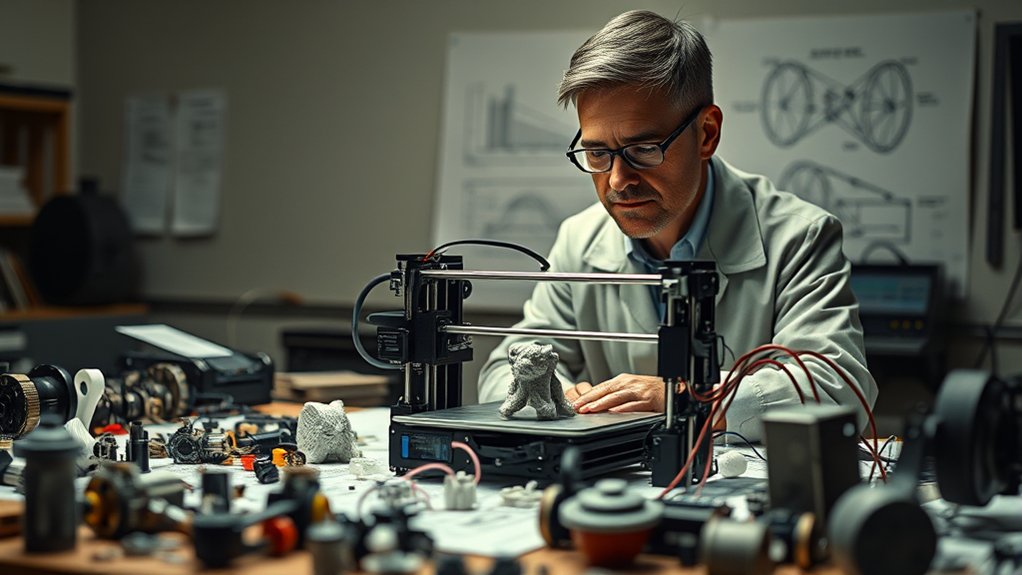

You can trace the invention of the 3D printer back to Chuck Hull, who in 1983 developed stereolithography—a process using ultraviolet light to solidify resin layer by layer.
Hull patented this technology in 1984, pioneering the first commercial 3D printer and setting the stage for additive manufacturing.
Following this, technologies like Selective Laser Sintering and Fused Deposition Modeling emerged in the 1980s and 1990s, broadening applications.
Exploring further reveals how this innovation reshaped industries and evolved rapidly over decades.
Key Takeaways
- Chuck Hull invented the first working 3D printer prototype using stereolithography in the early 1980s.
- Hull patented the stereolithography apparatus (SLA) in 1984, laying the foundation for modern 3D printing.
- His invention used ultraviolet light to solidify resin layers into 3D objects from digital designs.
- Hull’s work enabled rapid prototyping and complex geometries previously impossible with traditional methods.
- He founded 3D Systems, the first company to commercialize 3D printing technology for industrial use.
Who Invented the 3D Printer?
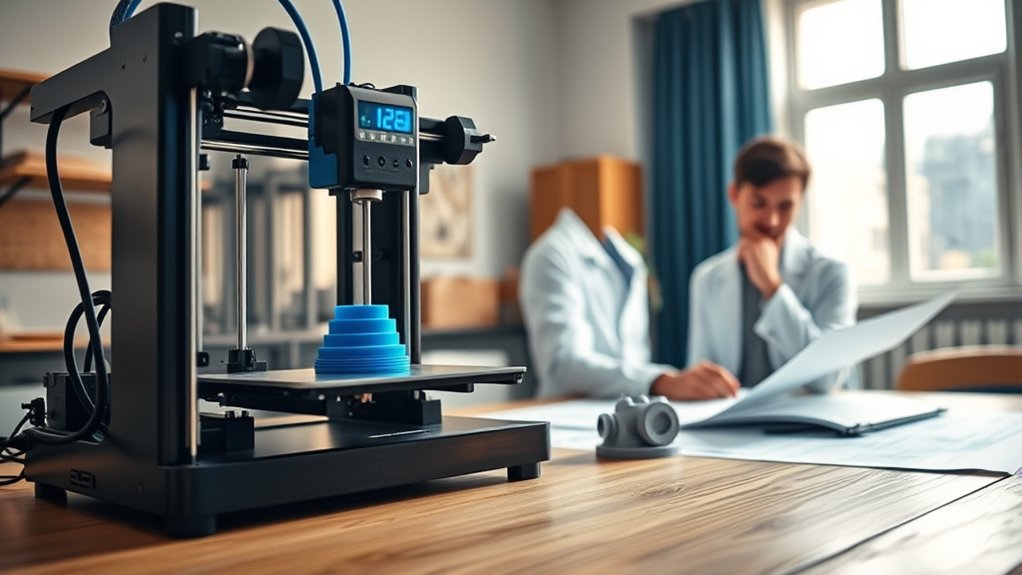
The invention of the 3D printer traces back to the early 1980s, when Chuck Hull developed the first working prototype of stereolithography, a process that uses ultraviolet light to solidify layers of resin into three-dimensional objects.
If you follow the history timeline, you’ll see Hull’s efforts started in 1983, marking a pivotal moment in additive manufacturing. His inventor biography shows a background in engineering and a keen interest in rapid prototyping, which drove him to create this groundbreaking technology.
What Is Stereolithography and How Did Chuck Hull Change 3D Printing?
You’ll want to start by understanding stereolithography, a process that builds 3D objects layer by layer using ultraviolet light to cure liquid resin.
Chuck Hull invented this technique in 1983, creating the first functional 3D printer and securing a patent that set the foundation for modern additive manufacturing. His innovation revolutionized how prototypes and parts are made, drastically speeding up production and enabling complex designs that were previously impossible.
Stereolithography Defined
Stereolithography revolutionized 3D printing by introducing a precise method to create complex objects layer by layer using ultraviolet light to cure liquid resin. You’ll find the stereolithography process starts with a digital 3D model, which guides a UV laser to solidify resin selectively.
This method excels in producing highly detailed prototypes and functional parts.
| Aspect | Details |
|---|---|
| Process | UV laser cures liquid resin layer-wise |
| Materials | Photopolymer resins |
| Applications | Prototyping, dental models, aerospace |
Understanding this process helps you appreciate how stereolithography applications span industries, shaping design and manufacturing with unmatched precision and speed.
Chuck Hull’s Key Innovation
A pivotal breakthrough in 3D printing came when Chuck Hull invented stereolithography in the early 1980s, transforming how objects are fabricated from digital designs. Hull developed a method that uses ultraviolet light to cure liquid photopolymer layer by layer, creating precise three-dimensional objects directly from CAD files.
This innovation allowed for rapid prototyping and complex geometries previously unattainable. You can see stereolithography applications across industries—from medical modeling to aerospace, where accuracy is critical.
By patenting this technology and founding 3D Systems, Hull set the foundation for commercial 3D printing. His legacy lies not just in the invention itself but in enabling widespread use of additive manufacturing, making rapid, accurate production accessible.
Understanding Hull’s contribution helps you appreciate how stereolithography shaped modern 3D printing’s evolution.
Impact on 3D Printing
Chuck Hull’s invention of stereolithography revolutionized how 3D printing operates by introducing a precise, layer-by-layer curing process using ultraviolet light. This breakthrough not only enhanced accuracy but also accelerated prototyping, reshaping manufacturing.
You witness socioeconomic implications as industries adopt more cost-effective, customizable production, expanding access and creating new job sectors. Environmentally, stereolithography reduces material waste compared to traditional subtractive methods, advancing sustainability.
| Before Stereolithography | After Stereolithography |
|---|---|
| Slow, imprecise prototyping | Rapid, highly accurate models |
| Limited customization options | Tailored, complex designs |
| High material waste | Efficient, eco-friendly use |
What Early 3D Printing Technologies Followed the First Printer?
After Chuck Hull’s stereolithography laid the foundation, you’ll see how early 3D printing methods like fused deposition modeling and selective laser sintering emerged, each driven by key inventors who pushed the technology forward.
You’ll track how these innovations evolved not only in technique but also in the materials they used, expanding the possibilities for manufacturing. Understanding this progression helps you appreciate the rapid advancement and diversification of 3D printing after its initial invention.
Early 3D Printing Methods
Although the first 3D printer laid the foundation, several distinct technologies quickly emerged to expand the possibilities of additive manufacturing. You’ll find that early techniques evolved in a clear chronological order, each building on previous innovations:
- Stereolithography (SLA) Introduced in the mid-1980s, this method used UV lasers to cure liquid resin layer-by-layer, refining precision in additive manufacturing.
- Selective Laser Sintering (SLS) Developed shortly after, SLS employed lasers to fuse powdered materials, allowing for complex, durable parts.
- Fused Deposition Modeling (FDM) This technique extruded thermoplastic filaments, making 3D printing more accessible and practical for prototypes.
- Laminated Object Manufacturing (LOM) Layered sheets of material were cut and bonded, offering a cost-effective approach for larger objects.
Each method enhanced additive manufacturing’s versatility, setting the stage for future advancements.
Key Inventors And Innovations
Three pioneering inventors played crucial roles in shaping early 3D printing technologies, each introducing innovations that expanded the scope of additive manufacturing.
After the first printer, Chuck Hull developed stereolithography (SLA) in 1984, using UV light to cure liquid resin layer-by-layer. In 1988, Scott Crump invented fused deposition modeling (FDM), extruding thermoplastic material to build objects. Meanwhile, Carl Deckard introduced selective laser sintering (SLS) in 1987, fusing powdered materials with a laser.
| Inventor | Innovation |
|---|---|
| Chuck Hull | Stereolithography (SLA) |
| Carl Deckard | Selective Laser Sintering (SLS) |
| Scott Crump | Fused Deposition Modeling (FDM) |
These breakthroughs broadened digital fabrication’s capabilities, enabling diverse materials and precise control in additive manufacturing.
Evolution Of Printing Materials
As 3D printing technologies advanced beyond the initial inventions, they embraced a wider array of materials that greatly enhanced their functionality and applications. You’ll notice the evolution in material selection reflects growing demands for application diversity and reduced environmental impact:
- Early printers primarily used basic thermoplastics, setting the stage for more complex materials.
- Introduction of biodegradable plastics addressed ecological concerns while expanding printing options.
- Metal composites emerged next, allowing for durable, functional parts in aerospace and automotive industries.
- Most recently, ceramic materials and flexible filaments have been developed, enabling intricate designs and elasticity in prints.
Each step in this progression improved printing technologies, letting you produce more specialized, sustainable, and versatile objects. Understanding this timeline helps you appreciate how material innovation drives 3D printing’s expanding capabilities.
How Did 3D Printing Develop Through the 1980s and 1990s?
When you look at the 1980s and 1990s, you’ll see rapid advancements that shaped 3D printing into a practical technology. Early adopters experimented with stereolithography and selective laser sintering, pushing boundaries.
Technological advancements improved precision, speed, and material compatibility, turning prototypes into functional parts.
| Year | Innovation | Impact |
|---|---|---|
| 1984 | Stereolithography (SLA) | Enabled layer-by-layer curing |
| 1987 | Selective Laser Sintering (SLS) | Expanded material options |
| 1990s | Improved software & hardware | Increased accuracy and usability |
Which Companies Helped Make 3D Printing Mainstream?
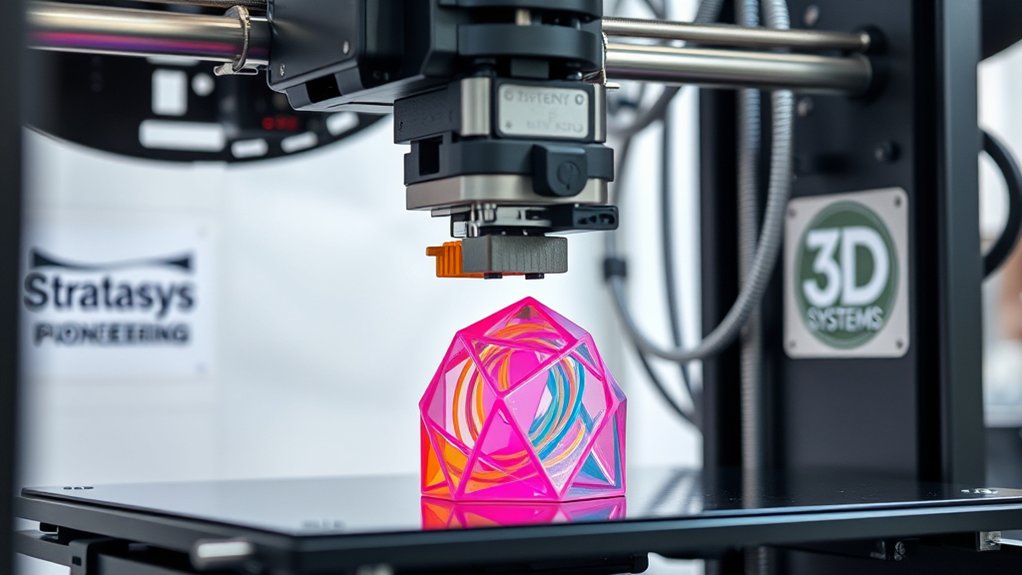
Although 3D printing technology had made significant strides by the 1990s, it was the strategic efforts of key companies that truly brought it into the mainstream. You can trace the mainstream adoption of 3D printing through these industry leaders:
Key companies in the 1990s transformed 3D printing from a niche technology to mainstream innovation.
- 3D Systems, founded by Chuck Hull, commercialized stereolithography, making 3D printing accessible beyond research labs.
- Stratasys, established by Scott Crump, introduced Fused Deposition Modeling (FDM), widely adopted in manufacturing.
- EOS pioneered selective laser sintering (SLS), expanding applications in aerospace and automotive sectors.
- MakerBot emerged in the 2000s, popularizing desktop 3D printers for consumers and education.
These companies chronologically advanced 3D printing from industrial niche to a versatile, mainstream technology, each contributing critical innovations that shaped the industry’s growth.
What Innovations Improved 3D Printers Over Time?
The efforts of companies like 3D Systems and Stratasys laid the groundwork for widespread 3D printing use, but continuous innovations fueled its rapid evolution. Initially, improvements focused on enhancing precision and speed.
As you explore the timeline, material advancements stand out. Moving from basic plastics to metals, ceramics, and composites expanded printing applications considerably. Around the 2000s, software integration became essential; you now benefit from sophisticated CAD tools and slicing software that optimize print accuracy and reduce errors.
Later, multi-material printing and improved layer adhesion technologies emerged, further increasing functional versatility. By integrating real-time monitoring and AI-driven adjustments, modern printers deliver higher consistency and efficiency.
These innovations, progressing methodically, have transformed 3D printing from a prototyping curiosity into a robust manufacturing tool.
How Has 3D Printing Transformed Industries Beyond Prototyping?
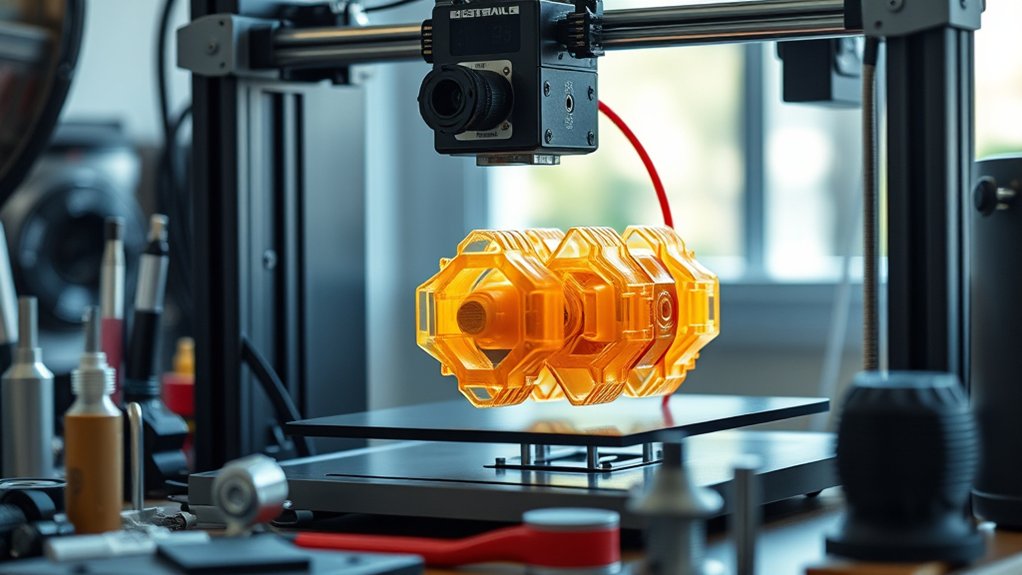
How exactly has 3D printing reshaped industries beyond its initial role in prototyping? As additive manufacturing applications expanded, you witnessed an industrial design revolution unfold.
First, in aerospace, complex, lightweight parts were produced faster and cheaper. Second, in healthcare, custom implants and prosthetics transformed patient care. Third, automotive manufacturers adopted 3D printing for end-use parts, enhancing performance and reducing inventory.
Fourth, consumer goods companies embraced rapid customization, offering personalized products on demand. This chronological evolution shows how 3D printing moved from a prototyping tool to a core manufacturing method, fundamentally altering production processes and supply chains.
You can see that this technology doesn’t just speed up design; it redefines how industries innovate, manufacture, and meet market demands efficiently.
Why Do the Origins of 3D Printing Matter Today?
Understanding the origins of 3D printing sheds light on why the technology has evolved into such a powerful force across industries today. The historical significance of early developments highlights how incremental innovations shaped the technological evolution we witness now.
Each phase, including conceptualization, patenting, and commercialization, built the foundation for current breakthroughs. Grasping this timeline helps you appreciate the challenges overcome and the potential future paths.
| Year | Milestone |
|---|---|
| 1981 | Early stereolithography concept |
| 1984 | Chuck Hull patents SLA printer |
| 1990s | Expansion into manufacturing |
| 2000s | Affordable desktop printers emerge |
| 2010s+ | Industry-specific customizations |
Knowing this, you can better understand 3D printing’s transformative role in today’s tech landscape.
Frequently Asked Questions
What Materials Can Modern 3D Printers Use?
You can use plastic filament for basic models, then move to metal powder for stronger, detailed parts. Modern 3D printers also handle resins and composites, expanding your material options as technology advances chronologically.
How Long Does It Take to Print a Typical 3D Object?
You’ll find print speed varies, object complexity dictates duration, and layer height affects quality. Typically, simple prints take minutes, while intricate ones require hours.
You’ll plan accordingly, balancing detail, speed, and functionality for ideal results.
Can 3D Printing Be Used for Food Production?
Yes, you can use 3D printing for food production. It advances food design by layering edible materials, enabling culinary innovation that customizes textures and flavors.
This technology is revolutionizing how chefs approach meal preparation and presentation.
Is 3D Printing Environmentally Friendly?
You’d be surprised to learn 3D printing can reduce waste by up to 90%. By adopting sustainable practices, it minimizes material use and supports waste reduction, making it an increasingly environmentally friendly manufacturing method over time.
What Are the Safety Concerns With 3D Printing at Home?
You should watch for fire hazards during prolonged printing and guarantee proper ventilation to avoid fume exposure.
First, set up your printer safely, then monitor it continuously, minimizing risks from overheating or toxic emissions in your home.
Conclusion
You’ve seen how 3D printing’s pioneering path, from Chuck Hull’s clever creation of stereolithography to the steady strides of subsequent technologies, sparked significant shifts in manufacturing. As companies continuously crafted clearer, quicker, and cost-effective machines, 3D printing transformed from tentative trials to tangible tools across industries.
Understanding these origins offers insight into ongoing innovations, inspiring you to appreciate the precise progression that’s propelled this powerful process into your present and future possibilities. Recognizing who invented the 3D printer helps highlight the foundation upon which this transformative technology continues to build.