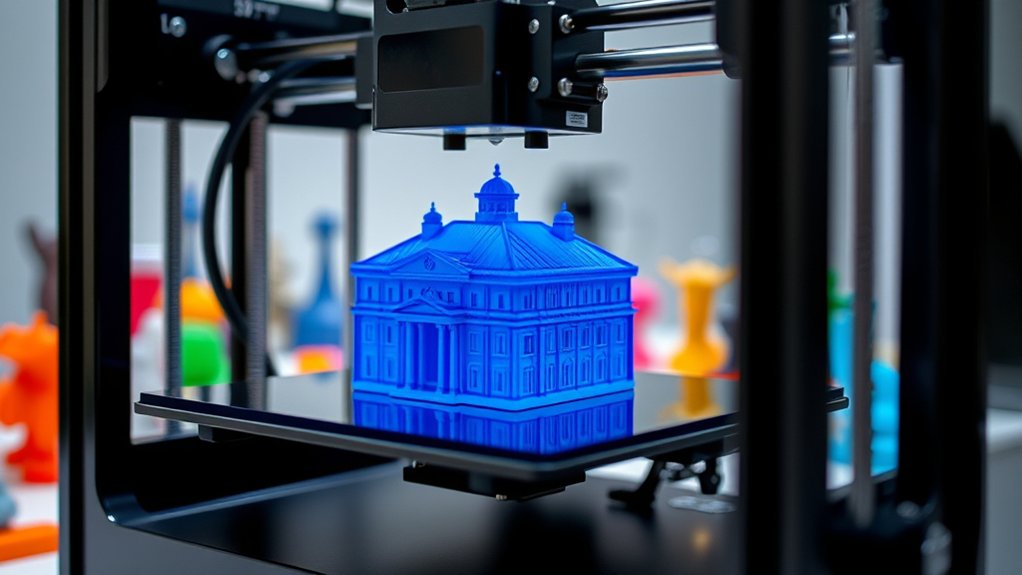

You can make a wide variety of items with a 3D printer, ranging from precise household objects like organizers to custom tools designed for specific tasks.
Using diverse filaments such as PLA or reinforced nylon allows for tailored functionality and strength.
Complex art pieces, functional wearable technology, and educational models that illustrate scientific concepts are also possible.
Rapid production of replacement parts boosts repair efficiency significantly.
Toys and game accessories created with a 3D printer can achieve fine detail and strong durability.
Entrepreneurs benefit from multi-material prints and on-demand manufacturing, enabling quick refinement of niche products.
Explore further to uncover detailed applications and material choices for your 3D printing projects.
Key Takeaways
– Custom household organizers, home decor, and ergonomic tools enhance functionality and style
through precise 3D printing designs.
– On-demand replacement parts reduce downtime with tailored geometry and material selection
for quick, efficient repairs.
– Intricate art, educational models, and scientific visualizations foster creativity and active learning
across disciplines.
– Personalized toys, game accessories, and wearable tech integrate complex designs and embedded sensors
for interactive experiences.
– Advanced 3D printing supports entrepreneurs in rapid product iteration, customization,
and innovative market positioning.
Everyday 3D Printed Household Items
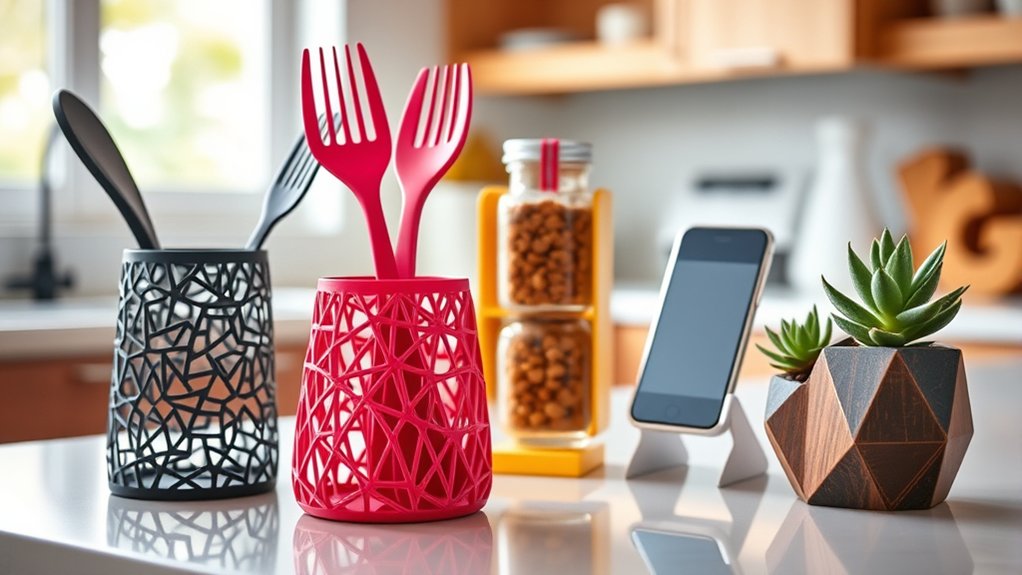
Many 3D printers can create durable, custom household items tailored to your specific needs. You can design and print kitchen organizers with precise compartments optimized for utensils, spices, or gadgets, ensuring efficient use of space.
Using CAD software, you control dimensions and material density, resulting in sturdy, functional pieces that fit your kitchen layout perfectly. For home decor, you can produce intricate, geometrically complex objects like vases, lampshades, or wall art, utilizing adjustable layer thickness and infill settings for aesthetic appeal and strength.
The ability to select filament types, such as PLA for rigidity or flexible TPU, enables you to customize texture and durability. With this technical control, 3D printing empowers you to fabricate personalized, practical items that enhance organization and style throughout your home.
Custom 3D Printed Tools and Replacement Parts
You can design and print custom tools tailored to specific tasks, optimizing ergonomics and functionality. When a part breaks, you’ll quickly manufacture durable replacements without waiting for shipping or dealing with discontinued inventory.
Using materials like reinforced nylon or PETG guarantees your components withstand mechanical stress and environmental factors.
Personalized Tool Designs
Custom 3D printed tools and replacement parts empower you to create precise, tailor-made solutions that fit specific tasks or repair needs. You can design custom tool handles optimized for grip and comfort, incorporating ergonomic designs that reduce hand fatigue during extended use.
By adjusting dimensions and contours digitally, you guarantee each handle matches your hand size and application requirements. Additionally, you can integrate features like textured surfaces or channels for improved control and reduced slippage.
When printing replacement parts, you achieve exact geometric conformity to original components, enabling seamless fit and function. The ability to iterate designs quickly allows you to refine tools for maximum efficiency.
Ultimately, personalized tool designs enhance usability and durability, leveraging the adaptability of 3D printing technology to meet your specialized demands.
Quick Replacement Manufacturing
Although traditional supply chains can cause delays, 3D printing lets you produce replacement parts on demand, drastically reducing downtime. When you face equipment failure, you can quickly design and print critical spare parts tailored to specific machinery specifications.
This capability is invaluable for emergency repairs, where waiting for standard components can halt operations. By utilizing additive manufacturing, you control material selection, geometry, and tolerances, ensuring functional compatibility with existing assemblies.
You can also iterate designs rapidly, optimizing parts for performance or fit without relying on external suppliers. This approach minimizes inventory costs and enhances responsiveness.
In sectors like manufacturing, automotive, or electronics, 3D printing empowers you to maintain continuous operation by swiftly addressing part failures through custom, precise, and readily available replacements.
Durable Custom Components
Durable components produced through 3D printing provide tailored solutions that meet specific operational demands and withstand rigorous use. When you design custom brackets, you can optimize geometry for load distribution, ensuring structural integrity under stress.
Using engineering-grade filaments or resin, you achieve enhanced mechanical properties suitable for demanding environments. Similarly, durable casings fabricated via additive manufacturing offer precise fits and impact resistance, protecting sensitive electronics or machinery parts.
By controlling infill density and layer orientation, you enhance strength and longevity, reducing failure rates. This approach enables rapid iteration and cost-effective production of replacement parts that match original specifications without delay.
Ultimately, 3D printing empowers you to create functional, resilient custom tools and components tailored to your unique operational needs.
Creative Art and Decorative Pieces
Sculptures, intricate models, and unique decor items come to life through 3D printing by precisely layering materials based on digital designs. When you create sculptural art, you can exploit the printer’s capability to render complex geometries, achieving fine details that traditional methods struggle to replicate.
The process involves slicing your 3D model into ultra-thin cross-sections, which the printer then constructs layer by layer using materials like PLA, resin, or metal composites. For decorative vases, you can design hollow structures with elaborate lattice patterns that balance aesthetics and structural integrity, impossible to produce via conventional manufacturing.
This precision enables you to customize surface textures and integrate functional elements seamlessly, transforming your artistic vision into tangible, high-resolution decorative pieces with both form and function.
3D Printed Wearable Tech and Fashion Accessories

You can design and print customizable smart jewelry that integrates sensors and connectivity for real-time data tracking. Flexible wearable devices, crafted from advanced polymers, conform precisely to your body for enhanced comfort and functionality. These innovations push the boundaries of fashion and technology through precise, layer-by-layer fabrication.
Customizable Smart Jewelry
Although traditionally seen as purely decorative, jewelry now integrates advanced technology through 3D printing, enabling the creation of customizable smart accessories that combine aesthetics with functionality. You can design and print smart ring designs embedded with sensors to monitor biometric data, such as heart rate or step count, seamlessly integrating electronics within intricate geometries.
Personalized bracelets benefit from precise layering techniques, allowing you to tailor size, pattern, and embedded modules like NFC chips or LED indicators. The additive manufacturing process provides exceptional resolution, facilitating complex internal channels for wiring and battery housing without compromising comfort.
Flexible Wearable Devices
Building on the integration of advanced electronics within smart jewelry, flexible wearable devices extend 3D printing capabilities to create adaptable, form-fitting tech accessories that conform to the body’s movements. By combining smart textiles with embedded wearable sensors, you can fabricate devices that maintain comfort and functionality simultaneously.
Here’s what you can achieve with 3D printed flexible wearables:
- Health Monitoring Bands: Integrate wearable sensors to track essential signs like heart rate and perspiration in real-time, embedded within stretchable smart textile substrates.
- Gesture-Controlled Gloves: Use flexible circuits printed onto textile layers to detect finger movements, enabling precise control of digital interfaces.
- Adaptive Fashion Accessories: Create dynamic, shape-shifting designs that respond to environmental stimuli or user input through embedded sensors and actuators.
These applications demonstrate how 3D printing advances the development of sophisticated, responsive wearable technology.
Educational 3D Printed Models and Science Projects
When exploring complex scientific concepts, 3D printed models provide tangible, accurate representations that enhance comprehension and engagement. You can create detailed 3D anatomy models to study human physiology with precision, or assemble educational kits that facilitate hands-on science experiments.
Physics demonstrations benefit from custom-designed apparatuses illustrating mechanical principles, while biology tools help visualize cellular structures and processes. Chemistry models allow you to construct molecular geometries and reaction mechanisms, improving spatial understanding.
Math manipulatives printed in 3D offer tactile learning aids for abstract concepts like geometry or topology. Additionally, you can reproduce history artifacts to investigate archaeological contexts and cultural heritage. Using a 3D printer, you’ll develop versatile, precise educational resources that foster active learning and deepen scientific insight across multiple disciplines.
Toys and Games You Can 3D Print at Home

If you want to create custom toys and games, a 3D printer offers unparalleled precision and flexibility. You can design intricate 3d printed action figures with articulated joints, ensuring smooth movement and durability through optimized layer orientation and infill density.
Additionally, you can fabricate precise board game accessories tailored to your favorite games, such as token holders or dice towers, using high-resolution printing for fine details. Here are three ideas to ponder:
- Custom 3d printed action figures with interchangeable parts, using durable PLA or PETG materials.
- Modular board game accessories designed for easy assembly and consistent fit.
- Puzzle pieces and game tokens with complex geometries, enabled by advanced slicing settings.
Advanced 3D Printing Projects for Entrepreneurs
Entrepreneurs can leverage advanced 3D printing techniques to develop highly specialized products that meet niche market demands. By utilizing precise layer-by-layer fabrication, you can create innovative prototypes with complex geometries unattainable through traditional manufacturing.
This capability accelerates product iteration cycles, enabling rapid refinement based on functional testing and user feedback. In business applications, advanced 3D printing supports customization, small-batch production, and on-demand manufacturing, reducing inventory costs and lead times.
You can design components with integrated features such as internal channels or flexible hinges, enhancing product functionality. Additionally, multi-material printing allows for combining rigid and elastic sections within a single print, broadening your product’s versatility.
Embracing these technologies empowers you to deliver tailored solutions efficiently, positioning your enterprise at the forefront of innovation and responsiveness in competitive markets.
Choosing Materials for Your 3D Prints
Material selection plays a critical role in determining the mechanical properties, durability, and functionality of your 3D printed objects. To optimize your prints, you must carefully evaluate material properties alongside print settings.
Choosing the right material is essential for enhancing your 3D print’s strength, durability, and performance.
Here are three key factors to take into account:
- Material Compatibility: Match the filament type (PLA, ABS, PETG, etc.) with your printer’s capabilities and project requirements. Each material demands specific temperature and speed settings.
- Mechanical Strength: Assess tensile strength, flexibility, and impact resistance based on the object’s intended use. For load-bearing parts, prioritize materials like PETG or ABS over PLA.
- Print Settings Optimization: Adjust nozzle temperature, bed temperature, and layer height according to the selected material to guarantee proper adhesion and minimize warping.
Frequently Asked Questions
How Long Does It Take to Print a Typical 3D Object?
It typically takes you 30 minutes to several hours to print a 3D object, depending on print speed and object complexity.
Faster speeds shorten time but may reduce quality, while intricate designs require longer printing sessions.
What Software Is Best for Designing 3D Printable Models?
You’ll find design software like Fusion 360 or Blender essential. They’re like your digital sculpting tools, mastering precise modeling techniques. Just like a painter needs brushes, these programs let you craft intricate, printable 3D models with technical accuracy.
Can 3D Printers Use Recycled Materials for Printing?
Yes, you can use recycled materials like PLA and PETG for 3D printing, enhancing sustainability benefits by reducing waste and conserving resources.
Different material types require specific printer settings for ideal print quality and durability.
Are 3D Printed Items Safe for Food Contact?
You can safely print cookie cutters using food safe materials like PLA and employ precise printing techniques to avoid contamination. Ensuring proper layer adhesion and post-processing guarantees the final item meets safety standards for food contact.
How Do I Maintain and Clean My 3D Printer?
You should regularly clean the print head to prevent clogs and recalibrate bed leveling for accurate prints. Use isopropyl alcohol on the bed and lubricate moving parts to guarantee smooth, precise printer operation.
Conclusion
Imagine turning a simple spool of filament into a custom wrench that saved your day—3D printing transforms ideas into precise, functional objects. With millions of accessible designs and materials, you’re not just printing parts; you’re creating solutions tailored to your needs.
Whether it’s household items, educational models, or entrepreneurial prototypes, your 3D printer is a versatile tool that bridges imagination and reality with exacting detail and efficiency.
In conclusion, the possibilities of what you can make with a 3d printer are virtually endless, limited only by your creativity and the materials at hand.