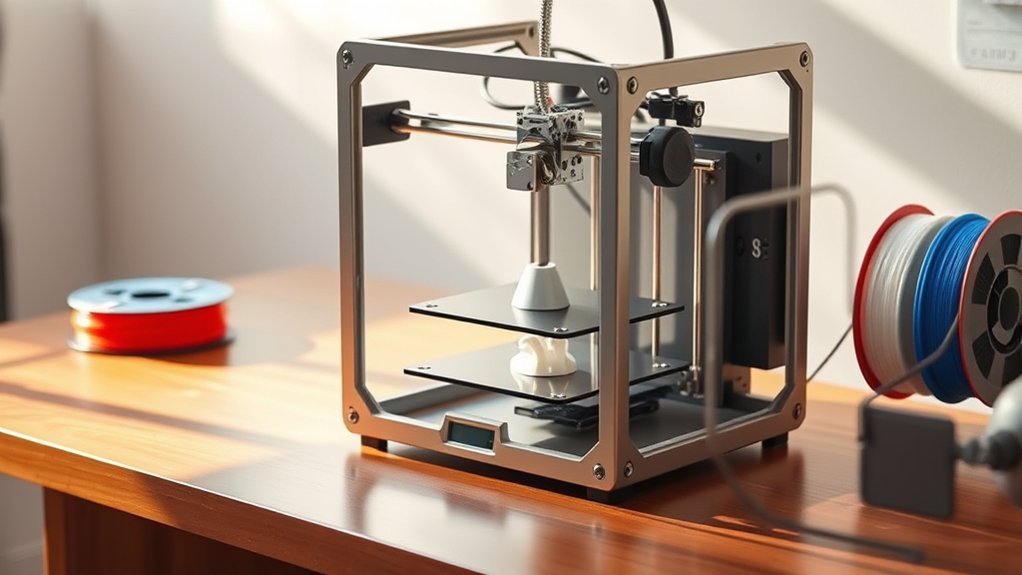

You can find 3D printers starting around $150 for basic entry-level models, which offer smaller build volumes and simpler features.
Mid-range printers typically cost between $500 and $1,500, providing better precision, larger build areas, and broader material compatibility.
Higher-end industrial units may cost several thousand dollars, incorporating advanced technologies and enhanced durability.
Keep in mind, additional features and ongoing expenses like materials and maintenance also impact overall cost.
Explore further to understand which model best fits your needs and budget.
Key Takeaways
- Entry-level 3D printers typically cost between $150 and $500, suitable for beginners and small projects.
- Mid-range models range from $500 to $1,500, offering better resolution, larger build volumes, and material options.
- High-end and industrial 3D printers can cost several thousand dollars due to advanced features and larger build capacities.
- Extra features like Wi-Fi connectivity, heated beds, and multi-material compatibility increase overall printer price.
- Consider ongoing costs such as filament, maintenance, and electricity when budgeting for a 3D printer.
Which 3D Printer Types Affect Price?
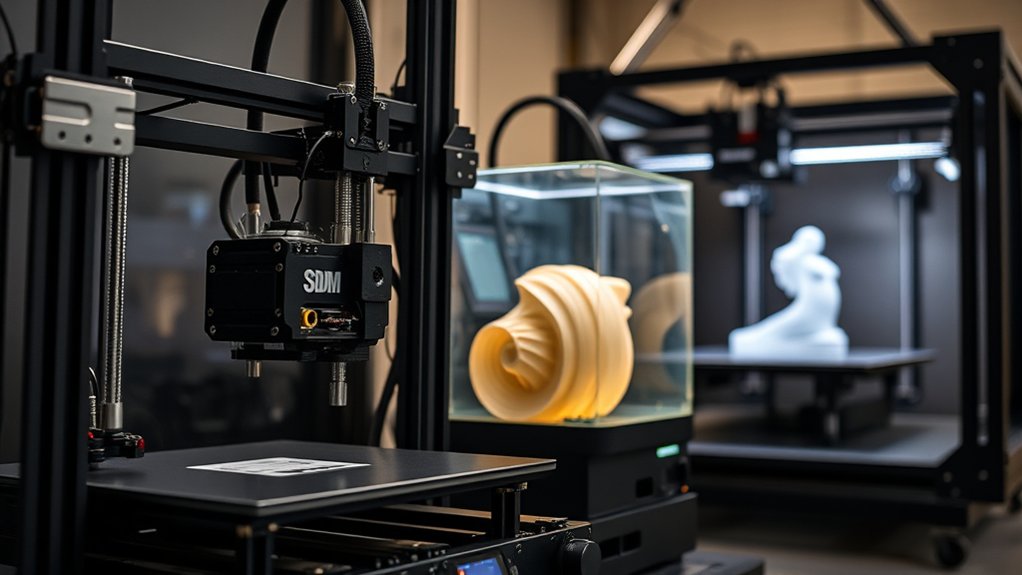
Although 3D printers share the same basic purpose, their underlying technologies greatly influence their cost. FDM printers, which use various filament types, typically offer lower entry prices and simpler user experiences, making them popular for hobbyists.
In contrast, SLA printers utilize advanced resin technologies, delivering higher precision but at increased expense. Industrial models incorporate both FDM and resin systems, boasting larger build volumes and superior material compatibility, which raises their price considerably.
Brand reputation also affects cost, as established manufacturers often charge premiums for reliability and support. When choosing, consider how build volume, material requirements, and user experience impact your needs.
Understanding these distinctions helps you evaluate the true value behind different 3D printer types and their corresponding price points.
How Much Do Entry-Level 3D Printers Cost?
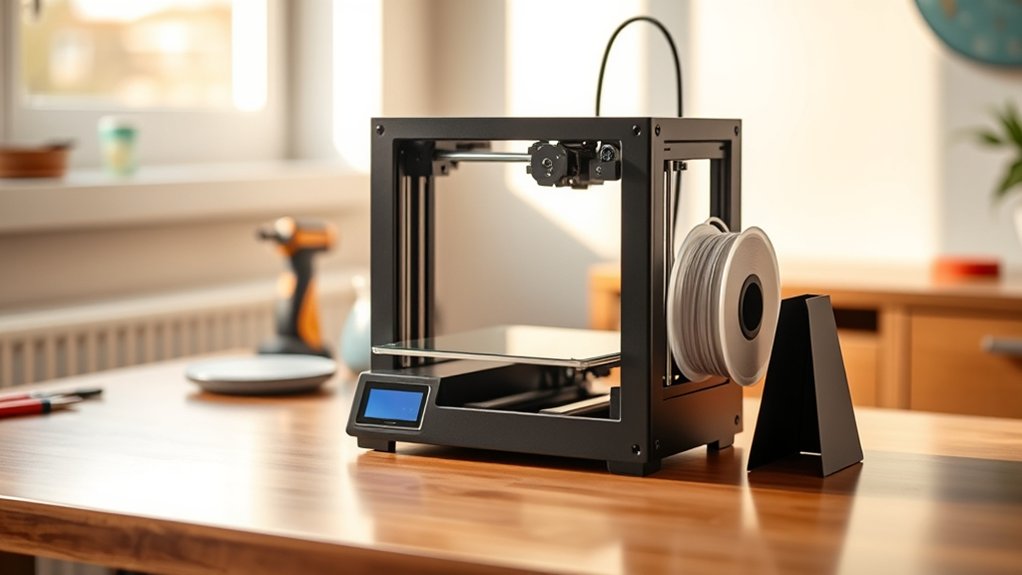
How much you’ll spend on an entry-level 3D printer depends largely on its features and capabilities. Entry level models typically range from $150 to $500, tailored for beginners who prioritize ease of use and affordability.
Entry-level 3D printers cost between $150 and $500, designed for beginners focusing on ease and affordability.
When choosing your first printer, consider these beginner considerations carefully:
- Build volume: Smaller print areas keep costs down but limit project size.
- Print resolution: Higher resolution means finer detail but may increase price.
- Material compatibility: Basic models often support PLA filament; advanced materials cost more.
- User interface: Intuitive controls and pre-calibrated settings simplify your startup experience.
What to Expect From Mid-Range 3D Printer Prices
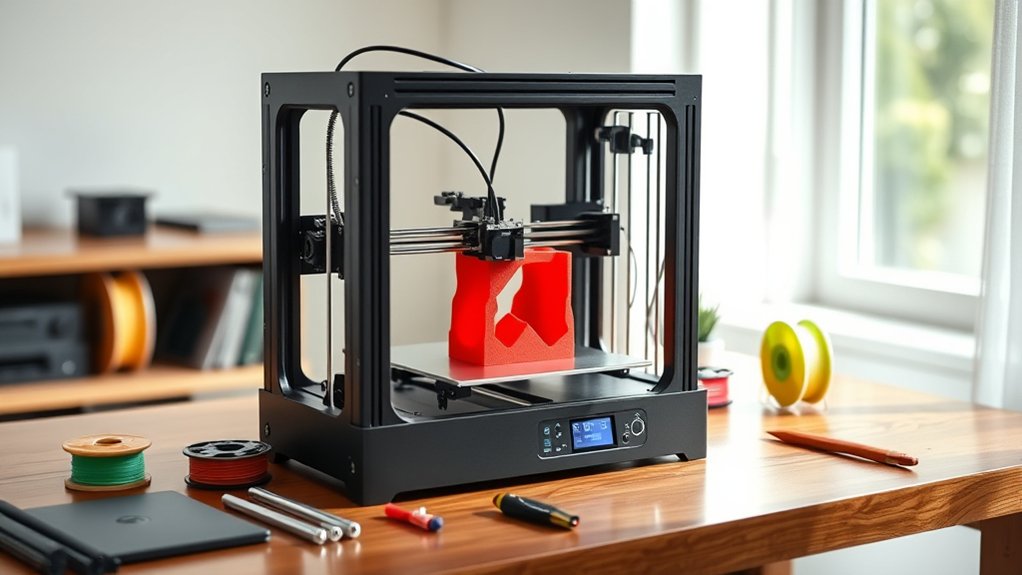
When you explore mid-range 3D printers, expect prices typically between $500 and $1,500. These models often include advanced features like improved print resolution, larger build volumes, and enhanced material compatibility.
You’ll find that this price point offers a solid balance of performance and value for both hobbyists and professionals.
Price Range Overview
Since mid-range 3D printers balance cost and capability, you can expect prices typically between $500 and $2,000. This range caters to users who have budget constraints but still want reliable performance aligned with current market trends. Within this bracket, printers generally offer improved precision and faster print speeds compared to entry-level models.
Consider these factors when evaluating mid-range prices:
- Quality of print resolution and layer height options
- Build volume suitable for diverse project sizes
- Compatibility with various filament materials
- Manufacturer support and warranty terms
Understanding these aspects helps you make informed decisions, ensuring you invest in a device that aligns with both your financial limits and functional requirements while reflecting evolving market standards.
Features Included
Though mid-range 3D printers come at a moderate cost, they include advanced features that enhance print quality and user experience. You can expect improved print speed, allowing faster production without sacrificing detail.
These printers typically offer larger build volumes than entry-level models, enabling you to create bigger or multiple parts in a single run. Precision components such as upgraded stepper motors and robust frame construction contribute to consistent layer accuracy.
Additionally, features like heated print beds and enhanced cooling systems improve material adhesion and reduce warping. Touchscreen interfaces and more intuitive software simplify operation and calibration.
With these capabilities, mid-range 3D printers strike a balance between performance and affordability, making them suitable for both hobbyists aiming for higher quality and professionals requiring reliable prototyping.
Value For Money
You can expect mid-range 3D printers to deliver a compelling balance between cost and capability, typically priced between $400 and $1,200. This segment offers superior price performance, making it ideal for hobbyists and small businesses seeking reliable output without overspending.
A thorough cost analysis reveals that these printers provide significant value through:
- Enhanced print resolution and speed compared to entry-level models
- Greater material compatibility, including specialty filaments
- Robust build quality ensuring longer operational lifespan
- User-friendly interfaces and community support accelerating learning curves
How Extra Features Add to 3D Printer Cost
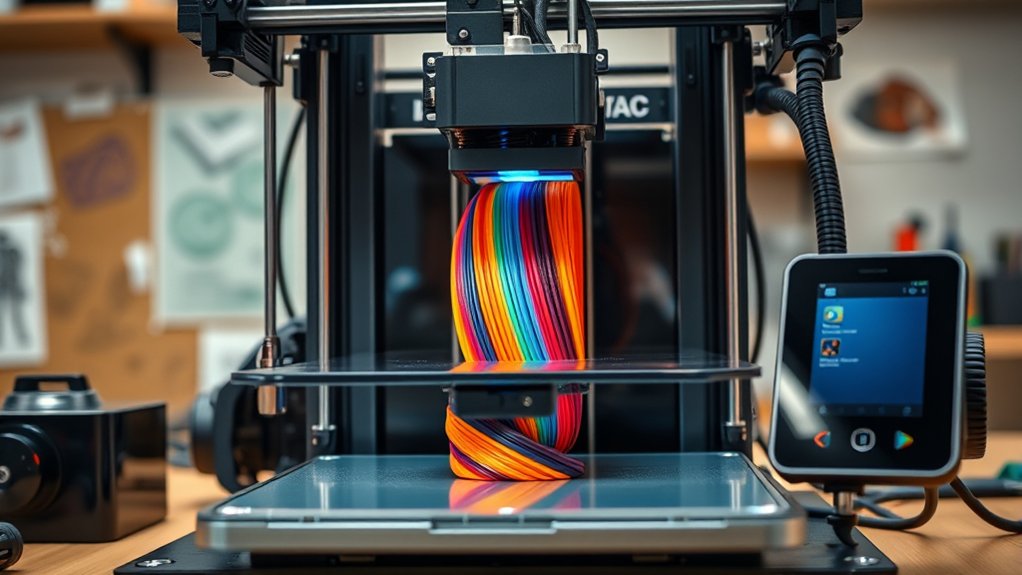
When choosing a 3D printer, consider how connectivity options like Wi-Fi or USB impact the overall cost. Enhanced print quality features, such as advanced nozzle technology or heated beds, also add to the price.
These extras improve performance but increase your initial investment.
Impact Of Connectivity Options
Because connectivity options directly influence a 3D printer’s usability and convenience, they greatly affect its cost. When you choose a model with advanced connectivity, you gain features like wireless printing and enhanced network compatibility, which streamline your workflow but add to the price. These options reduce reliance on physical media and enable remote monitoring or control.
Consider these connectivity aspects that impact pricing:
- Wireless printing capabilities requiring robust hardware and firmware
- Ethernet or Wi-Fi network compatibility for seamless integration
- Cloud-based printing support to access files from multiple devices
- USB and SD card slots for offline versatility
Each added feature demands more sophisticated electronics and software, increasing manufacturing complexity and overall printer cost. Selecting connectivity options aligned with your needs helps balance convenience against budget.
Role Of Print Quality Enhancements
Although 3D printers come with basic printing capabilities, investing in print quality enhancements greatly elevates output precision and surface finish. When you opt for advanced features like higher print resolution, you achieve finer layer heights and more detailed models.
These enhancements often include improved stepper motors, better extruders, and precision-calibrated rails, all contributing to consistent accuracy. Additionally, enhanced material compatibility allows you to use diverse filaments such as flexible, composite, or high-temperature materials, broadening your project scope.
These upgrades require sophisticated hardware and firmware, which increase manufacturing costs and, consequently, retail prices. If you prioritize sharp detail and versatile material use, expect to pay more for these quality enhancements.
Ultimately, the cost reflects the added capability to produce professional-grade prints with superior dimensional accuracy and surface quality.
Ongoing Expenses to Budget Beyond Your 3D Printer
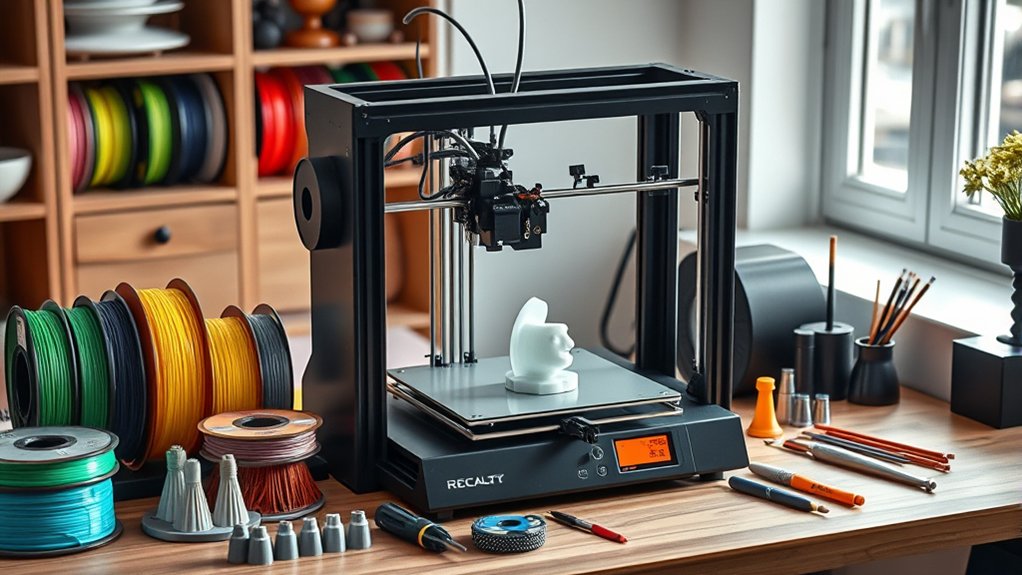
Even after purchasing a 3D printer, you’ll need to account for ongoing expenses that impact your total cost of ownership. These include maintenance costs and material expenses, which can add up considerably over time.
To keep your printer running efficiently, you’ll regularly replace worn parts and perform calibration. Additionally, filament or resin supplies vary in price depending on quality and type. Keep these recurring costs in mind:
- Replacement nozzles, belts, and build plates for maintenance
- Filament spools or resin cartridges as consumable materials
- Electricity consumption during print operations
- Software updates or licenses for advanced features
Budgeting for these elements guarantees you avoid surprises and maintain consistent print quality throughout your 3D printing projects.
When Are High-End 3D Printers Worth It?
When should you consider investing in a high-end 3D printer? Opt for one when your projects demand precision, durable materials, or complex geometries that entry-level models can’t handle. The high end benefits include enhanced resolution, faster print speeds, and advanced software integration, which are essential for professional applications like prototyping, manufacturing, or medical modeling.
| Criteria | High-End 3D Printer Benefits |
|---|---|
| Precision & Detail | Micron-level accuracy for intricate designs |
| Material Compatibility | Supports advanced and composite materials |
| Speed & Efficiency | Reduced print times for faster project turnaround |
If your work requires these capabilities, the investment in a high-end 3D printer will increase efficiency and product quality, justifying the cost.
How to Choose a 3D Printer That Fits Your Budget
How do you select a 3D printer that meets your technical needs without exceeding your budget? Start by defining your budget considerations clearly.
Next, evaluate printer features critical to your projects, such as print resolution, build volume, and material compatibility. Balance cost against these features to guarantee value without overspending.
Consider the total cost of ownership, including maintenance and consumables.
Focus on these key points:
- Prioritize essential printer features that align with your intended applications.
- Compare printers within your budget range, noting trade-offs in capabilities.
- Factor in ongoing expenses like filament costs and replacement parts.
- Research user reviews to assess reliability and customer support.
This approach helps you choose a 3D printer that fits your budget while delivering the performance you require.
Frequently Asked Questions
What Materials Can 3D Printers Use for Printing?
You can use various filament types like PLA, ABS, and PETG or resin options including standard, tough, and flexible resins. Each material suits different printing needs, offering unique strength, flexibility, and finish qualities for your projects.
How Long Does It Take to Print a Typical 3D Object?
You’ll find that print speed and object complexity mainly determine how long it takes to print a typical 3D object. Simple models may take under an hour, while intricate designs can require several hours or even days to complete.
Are 3D Printers Safe to Use at Home?
Think of your 3D printer as a precise sculptor; with proper ventilation, fire-safe setup, and filtered air, 3D printer safety guarantees home usage is secure.
Always follow manufacturer guidelines to avoid fumes or mechanical hazards effectively.
Can I Use 3D Printers for Commercial Purposes?
You can use 3D printers for commercial purposes, opening diverse business opportunities. However, you must consider legal considerations like intellectual property rights and compliance with industry regulations to guarantee your commercial use remains lawful and profitable.
What Software Is Required to Operate 3D Printers?
Think of slicing software as your printer’s blueprint. It converts 3D models into precise layers your printer reads. Pair it with modeling programs to design objects, ensuring you control every detail before printing starts.
Conclusion
Choosing the right 3D printer isn’t just about the price tag—it’s about balancing features, quality, and ongoing costs to fit your needs. Whether you’re eyeing an entry-level model or a high-end machine, remember: the cheapest option might cost more in the long run.
Like building a puzzle, every piece—printer type, features, and maintenance—matters. So, invest wisely to create prints that truly bring your ideas to life without breaking the bank.
When considering how much is a 3d printer, keep in mind that the initial cost is just one part of the equation.