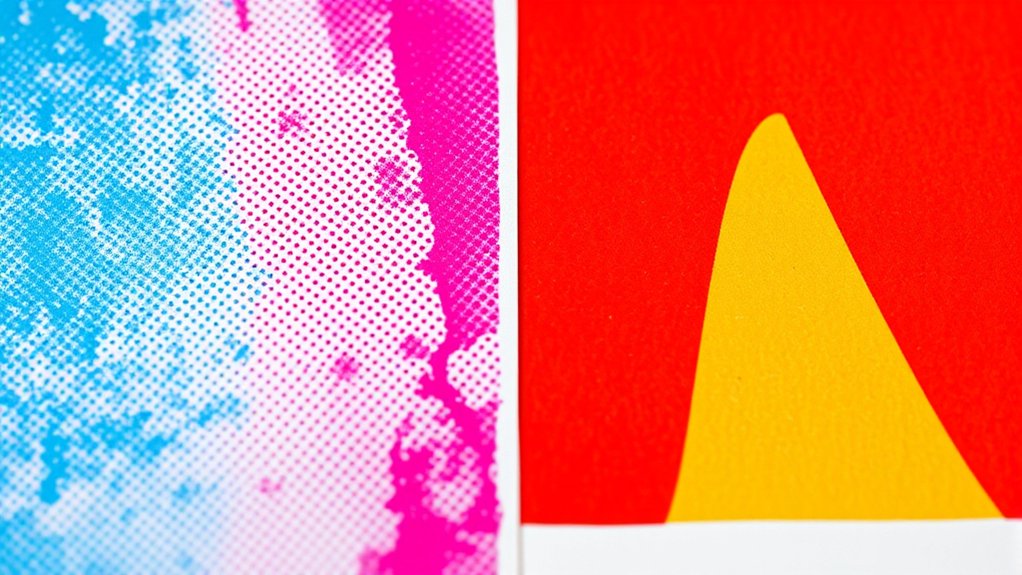

Risograph vs screen printing: if you need fast, cost-effective prints with vibrant, semi-transparent colors, risograph printing suits you well.
It’s great for medium runs and simpler designs but offers moderate detail resolution.
Screen printing, on the other hand, excels in sharp, high-resolution prints with rich, opaque inks across various substrates.
This makes it ideal for intricate designs and fabric applications despite higher setup time and costs.
Keep exploring to understand which method matches your project needs best.
Key Takeaways
- Risograph printing uses translucent inks with moderate detail, ideal for vibrant, cost-effective medium runs and simple color designs.
- Screen printing offers higher resolution, opaque colors, and tactile ink texture, making it suitable for intricate, multicolor, and fabric projects.
- Risograph setup is quick and low-cost, perfect for zines and posters, while screen printing requires longer, pricier setup but excels in large volumes.
- Screen printing supports extensive color ranges and finer detail, whereas Risograph is limited to spot colors with a grainy texture.
- Risograph is more sustainable with soy-based inks and low waste; screen printing provides durability and thickness ideal for apparel and promotional items.
Risograph Printing: Process and Unique Features
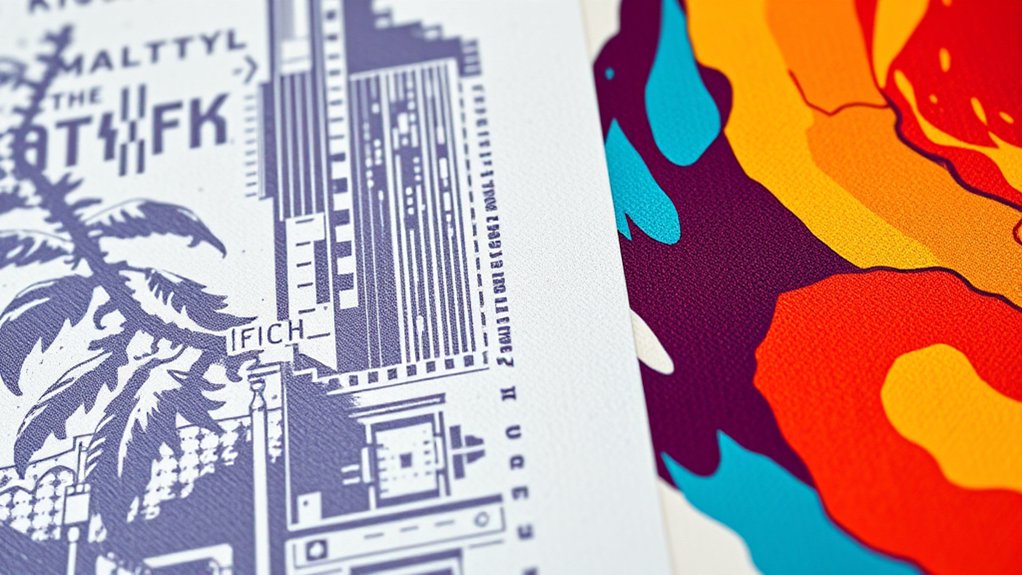
Although risograph printing shares similarities with traditional duplicating methods, it employs a distinct stencil-based process that sets it apart. You start by creating a master stencil directly from your original artwork or document. The machine then forces ink through this stencil onto paper, layer by layer.
Risograph colors are unique, often vibrant and semi-transparent, allowing you to overlay hues for varied effects. The process runs quickly and efficiently, making it ideal for medium to large print runs.
Vibrant, semi-transparent risograph colors layer beautifully, delivering quick, efficient prints perfect for medium to large runs.
From a sustainability perspective, risograph printing excels due to its minimal waste, low energy consumption, and soy-based inks. You’ll appreciate how risograph sustainability aligns with eco-conscious practices, reducing environmental impact without compromising print quality.
This combination of speed, color vibrancy, and eco-friendliness defines its distinctive appeal.
Screen Printing: Process and Key Features
When you use screen printing, you’ll apply ink through a mesh stencil to transfer images onto various surfaces. This method works well with materials like fabric, paper, and plastics due to its versatility and durability.
Understanding the specific technique and compatible materials guarantees you get maximum print quality and longevity.
Screen Printing Technique
A screen printing technique relies on forcing ink through a fine mesh stencil to create precise, repeatable designs on various surfaces. You start by preparing a mesh screen coated with a light-sensitive emulsion. After exposing it to your design, you wash away unexposed areas, forming a stencil.
During ink application, you place the screen over the substrate and use a squeegee to push ink through the open mesh areas. This controlled ink application guarantees sharp edges and consistent coverage.
Screen printing techniques allow for layering multiple colors by repeating the process with separate screens. You’ll find this method highly effective for detailed patterns, solid fills, and vibrant colors.
Mastering ink viscosity and squeegee pressure is key to achieving consistent results across runs.
Material Compatibility
The effectiveness of screen printing depends heavily on choosing the right materials to guarantee ideal ink adhesion and durability. Understanding substrate compatibility is vital for ensuring your prints maintain quality and longevity.
Different paper types and other substrates react uniquely to screen printing inks and processes, so selecting compatible materials is essential.
Key considerations include:
- Paper types: uncoated, coated, textured, and synthetic papers vary in ink absorption
- Fabric substrates: cotton, polyester, blends, and specialty textiles demand tailored ink formulations
- Surface porosity: affects ink penetration and drying time
- Ink type compatibility: plastisol, water-based, and solvent-based inks perform differently on substrates
- Durability requirements: outdoor exposure vs. indoor use influences material choice
Print Quality and Color: Risograph Vs Screen Printing
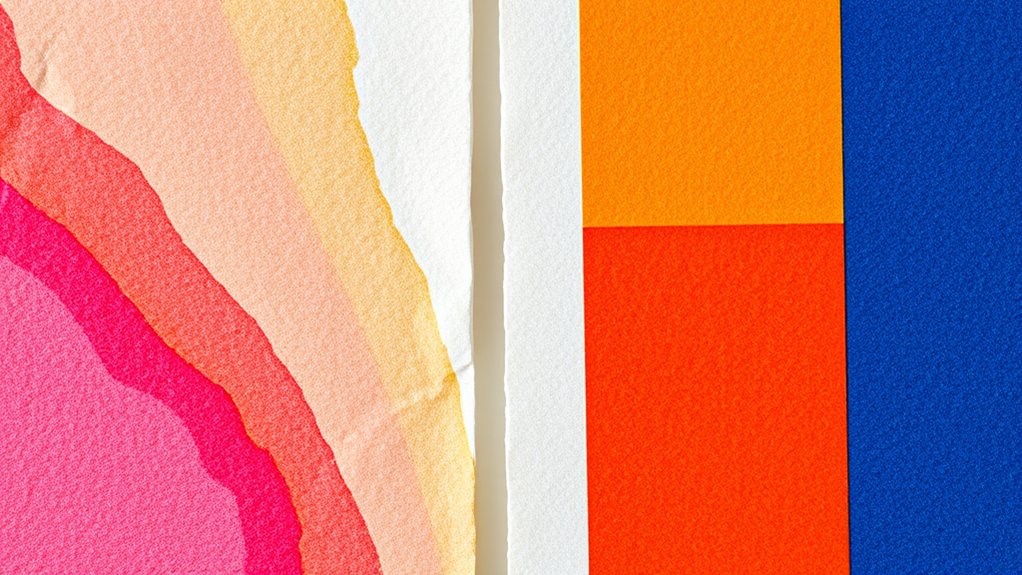
When comparing print quality, you’ll notice Risograph offers vibrant, slightly translucent colors, while screen printing produces richer, more opaque hues.
You’ll also find Risograph captures fine details differently due to its lower resolution, whereas screen printing excels in sharpness and texture depth.
Finally, the ink texture contrasts greatly: Risograph’s matte finish feels thin, but screen printing provides a thicker, tactile surface.
Color Vibrancy Comparison
Understanding how color vibrancy manifests in Risograph and screen printing is essential for selecting the right technique for your project. Risograph printing achieves vibrancy through translucent inks and precise color layering, allowing for rich, luminous hues.
However, ink saturation is limited compared to screen printing, which employs thicker ink deposits for intense, opaque colors. Screen printing’s higher ink saturation enhances color depth but may risk slight texture build-up.
When comparing these methods, consider:
- Risograph’s semi-transparent layering for subtle gradients
- Screen printing’s dense ink application for bold vibrancy
- Impact of substrate absorption on color intensity
- Variability in color mixing with Risograph’s limited ink palette
- Durability of inks under different environmental conditions
This nuanced understanding helps you optimize color vibrancy tailored to your print objectives.
Detail and Resolution Differences
Although both Risograph and screen printing offer distinctive aesthetic qualities, they differ markedly in detail and resolution capabilities. When you examine print resolution, Risograph typically operates at approximately 150-300 dpi, which limits its ability to reproduce fine lines and intricate details with high clarity. This results in a slightly grainy texture, characteristic of Risograph prints.
In contrast, screen printing allows for higher print resolution, especially when using finer mesh screens, enabling superior detail clarity and sharpness. You’ll notice screen printing captures delicate patterns and subtle gradients more effectively. However, this precision depends on mesh count and stencil quality.
Ultimately, if your project demands crisp, high-resolution details, screen printing provides a technical advantage, whereas Risograph excels in producing bold, textured imagery with moderate resolution.
Ink Texture and Finish
Beyond resolution and detail, the texture and finish of inks play a significant role in defining the final print quality between Risograph and screen printing. With Risograph, you’ll notice higher ink absorption into the paper, resulting in a matte, slightly grainy texture.
In contrast, screen printing deposits thicker ink layers that sit atop the substrate, providing a glossier, more tactile finish with superior finish durability. When choosing between these methods, consider:
- Risograph’s porous ink layer versus screen printing’s dense ink film
- Matte versus glossy finish effects
- Ink absorption rate impacting color vibrancy
- Finish durability under physical wear and environmental exposure
- Textural variance influencing tactile perception
Understanding these factors helps you select the ideal print process for your project’s aesthetic and longevity requirements.
Cost and Setup Time: Risograph Vs Screen Printing
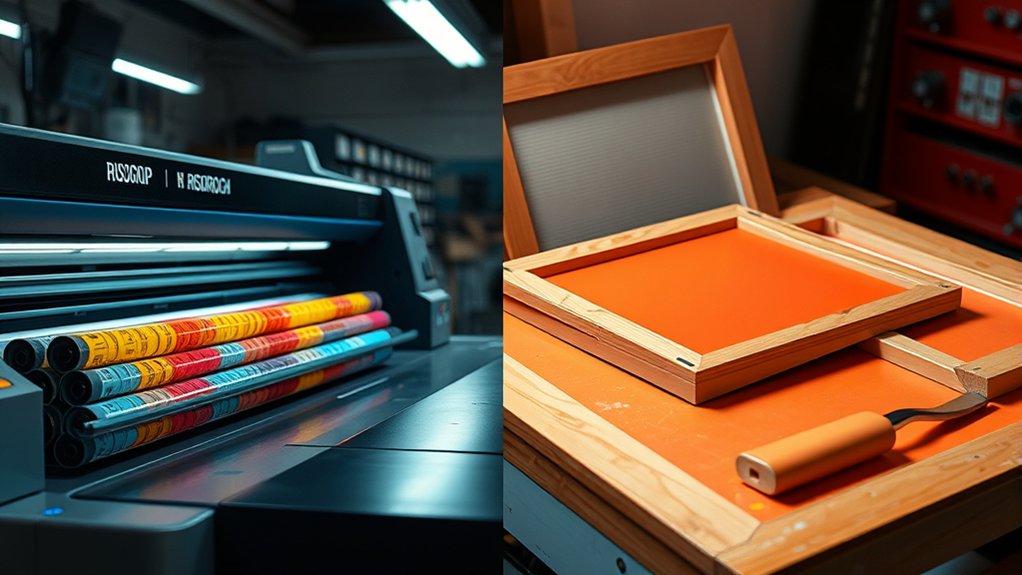
When comparing Risograph and screen printing, you’ll find significant differences in both cost and setup time that directly affect project feasibility. Risograph printing offers lower setup costs since it uses digital master templates rather than physical screens, streamlining preparation.
This results in superior time efficiency for short to medium runs, as you can quickly produce prints without extensive manual setup. Conversely, screen printing demands higher upfront setup costs due to screen preparation, stencil creation, and ink mixing, making it less time-efficient initially.
However, once screens are ready, screen printing excels in high-volume runs due to faster per-piece output. Understanding these cost and time dynamics helps you choose the right method based on your project scale and timeline requirements.
Best Projects for Risograph and Screen Printing
Both Risograph and screen printing excel in specific project types based on their technical strengths. You’ll find Risograph ideal for high-volume, cost-effective printing with vibrant, layered colors, making it perfect for zine publications, limited editions, and event materials.
Screen printing offers durability and versatility on diverse substrates, excelling in fabric designs, poster designs, and promotional items.
Consider these projects for each method:
- Risograph: zine publications, book covers, limited editions, illustrations, stationery items
- Screen Printing: fabric designs, poster designs, promotional items, event materials, art prints
Which Printing Method Should You Choose?
How do you determine the best printing method for your project? Focus on your design complexity, budget, and production volume. Risograph advantages include high-speed output and cost-efficiency for large runs with limited colors.
However, screen printing drawbacks like setup costs and time make it less suitable for small batches or highly detailed multicolor designs. Consider the following comparison:
| Factor | Risograph | Screen Printing |
|---|---|---|
| Setup Time | Minimal | Lengthy |
| Color Range | Limited (spot colors) | Extensive (multicolor) |
| Cost Efficiency | High for large runs | Higher upfront costs |
| Detail Resolution | Moderate | High |
| Suitable Projects | Posters, zines, flyers | Apparel, intricate designs |
Choose risograph for economical, fast, simple-color prints. Opt for screen printing when detail and color variety are priorities despite screen printing drawbacks.
Frequently Asked Questions
How Environmentally Friendly Are Risograph and Screen Printing?
You’ll find Risograph uses eco friendly materials and excels in waste reduction, while screen printing often involves more chemicals and water.
Choosing Risograph helps minimize environmental impact through efficient ink usage and less material waste overall.
Can Risograph Printing Handle Photographic Images Well?
You can achieve decent photographic quality with Risograph printing, but it struggles with fine image detail compared to other methods. Its halftone dots limit sharpness, so it’s best for stylized or less detailed photographic images.
What Types of Ink Are Used in Screen Printing?
You’ll find screen printing uses water based inks for eco-friendly, soft finishes and plastisol inks for durability and vibrant colors.
Both inks flow through the mesh, symbolizing precision and permanence in your printed designs.
How Durable Are Prints From Risograph Compared to Screen Printing?
You’ll find print longevity higher in screen printing due to thicker ink layers and durable inks. Durability factors like substrate type and environmental exposure also impact risograph prints, which generally offer less resistance to wear and fading.
Are There Any Limitations on Paper Types for Risograph Printing?
Isn’t paper compatibility essential for ideal results? You’ll find risograph printing favors uncoated, absorbent papers to guarantee ink adhesion. Texture preferences matter since slick or heavily coated stocks can cause smudging or incomplete prints.
Conclusion
Now that you’ve explored the intricate processes, print qualities, and cost factors of Risograph and screen printing, the choice isn’t as straightforward as it seems. Each method’s strengths cater to different project needs and budgets.
But which one truly aligns with your specific goals, color demands, and timeline? The answer lies in understanding your priorities—so, before you commit, weigh these technical nuances carefully.
Your perfect print solution is just a decision away, and choosing between Risograph vs screen printing depends on what fits your project best.