

When you engage in reading on screen, you benefit from convenience and instant access but face challenges like increased eye strain and potential distractions.
This mode offers digital formats with search functions and adjustable text, making it easy to navigate and customize your reading experience.
Print reading, by contrast, enhances comprehension and retention through tactile and spatial cues.
It causes less fatigue and supports better focus, as the physical interaction with paper aids memory.
Understanding these differences can help you choose strategies that maximize your engagement and efficiency across both media.
Key Takeaways
- Reading in print enhances comprehension and retention through tactile and spatial cues, unlike digital reading which encourages skimming and reduces deep processing.
- Extended screen reading causes more eye strain and fatigue due to blue light emission and screen flicker compared to the softer, ambient light reflection of print.
- Digital reading offers convenience with instant access to vast content, adjustable fonts, and search functions, improving usability and accessibility for diverse users.
- Print books provide tactile feedback and spatial navigation cues that aid memory and focus, while digital reading relies on interactive hyperlinks and minimal tactile interaction.
- Print reading naturally supports sustained attention with fewer distractions, whereas digital reading requires active management of notifications and multitasking temptations.
Reading on Screen Vs. Print: Effects on Comprehension and Retention

Although digital reading has become increasingly prevalent, research indicates that reading on screen can affect comprehension and retention differently than reading in print. You’ll find that comprehension differences arise because digital formats often encourage skimming rather than deep reading, reducing your ability to process complex information thoroughly.
When you read printed material, you tend to engage more cognitively, which enhances understanding and critical analysis. Additionally, retention rates generally decline with screen reading, as tactile and spatial cues present in print help anchor information in memory.
Digital reading’s scrolling and hyperlinks can disrupt your focus, further impacting retention. To optimize learning, you should consider these comprehension differences and retention rates, especially when dealing with dense or technical texts where information absorption is critical.
Eye Strain and Fatigue: Comparing Digital and Paper Reading
When you spend extended periods reading on digital screens, your eyes often experience more strain and fatigue compared to reading printed materials. Digital devices emit blue light, which can disrupt your natural visual comfort by causing glare and reducing contrast, making prolonged reading more taxing.
In contrast, printed text reflects ambient light, providing a stable and softer viewing experience that minimizes eye muscle fatigue. Additionally, screen flicker and pixelation can increase the effort your eyes must exert to maintain focus, leading to symptoms such as dryness, irritation, and blurred vision.
While some screens offer adjustable brightness and filters to reduce blue light exposure, these measures rarely replicate the inherent visual comfort of paper. Consequently, when prioritizing eye health during extended reading, paper remains the less fatiguing choice.
Why Digital Reading Is More Convenient and Accessible
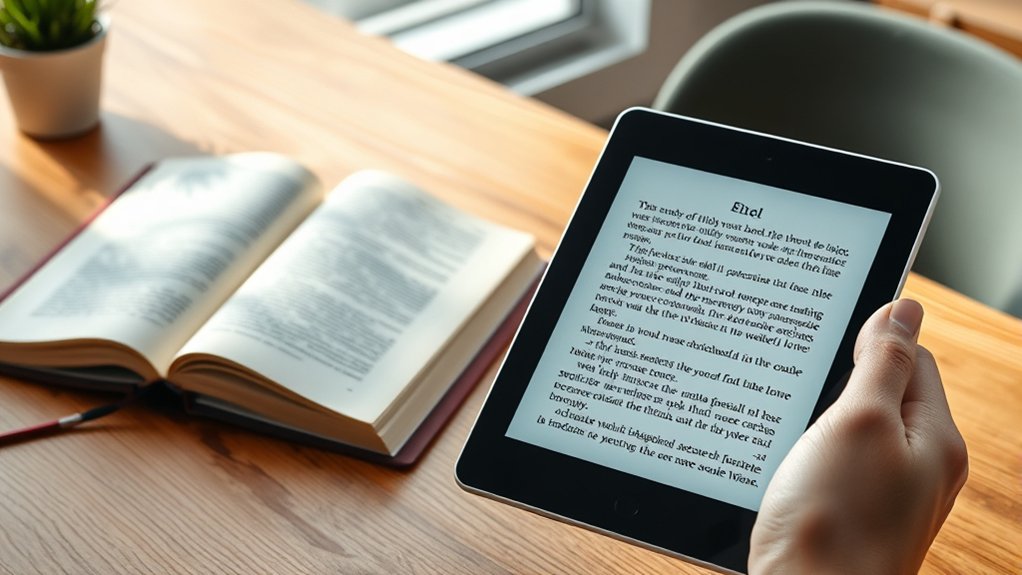
Because digital devices store vast amounts of content in compact formats, you can access a wide range of reading materials instantly without physical constraints. This immediacy highlights significant e book advantages, such as reduced storage needs and instant availability, which print books cannot match.
Additionally, mobile access allows you to carry entire libraries on handheld devices, making reading feasible anywhere and anytime. Digital platforms often provide adjustable fonts and search functions, enhancing usability and personalization.
These features increase accessibility for diverse users, including those with visual impairments. Consequently, digital reading offers a level of convenience and inclusivity that print cannot provide, streamlining your experience by removing logistical barriers and adapting to varied contexts and preferences efficiently.
This accessibility reshapes how you engage with texts in your daily life.
How Navigating Digital and Print Books Affects Your Reading Experience
As you navigate digital and print books, the distinct physical and interactive elements of each format directly influence your reading experience. Digital interfaces offer dynamic navigation tools like hyperlinks and search functions, enhancing efficiency but sometimes reducing spatial orientation.
Conversely, print books provide tactile feedback through paper texture and page turning, aiding memory and comprehension by reinforcing physical interaction.
| Aspect | Digital Books |
|---|---|
| Navigation | Interactive hyperlinks, search functions |
| Physical Interaction | Minimal tactile feedback |
| Aspect | Print Books |
| Navigation | Manual page turning, spatial cues |
| Physical Interaction | Rich tactile feedback, paper texture |
Understanding these differences helps you optimize your reading strategies for each medium.
Which Reading Method Boosts Focus and Reduces Distractions Better?

The distinct features of digital and print books not only shape how you navigate and interact with the text but also influence your ability to maintain focus and limit distractions. When you read in print, you benefit from tactile cues and a fixed layout, which support effective focus techniques by reinforcing spatial memory and reducing cognitive load.
Conversely, reading on a screen often exposes you to notifications and multitasking temptations, challenging your distraction management efforts. However, digital platforms do offer customizable settings, like adjustable fonts and blue light filters, that can enhance concentration when used appropriately.
Ultimately, print reading inherently fosters better sustained attention through fewer external interruptions, while digital reading demands more deliberate focus techniques and proactive distraction management to maintain comparable engagement levels. You must assess your environment and habits to determine which method better suits your focus needs.
Frequently Asked Questions
How Do Costs Compare Between Digital and Print Books?
You’ll find price differences favor digital books due to lower production costs, but subscription models often make screen reading more economical over time.
Print books have higher upfront costs, reflecting physical materials and distribution expenses.
What Environmental Impacts Do Digital and Print Reading Have?
You’ll find print books have a higher carbon footprint due to paper production and resource usage, while digital reading lowers paper waste but involves energy consumption from devices. Both options are environmentally impactful in different ways.
Can Digital Reading Improve Literacy in Children?
Imagine a garden where digital literacy seeds grow faster; by integrating interactive tools, you can cultivate stronger reading habits in children.
Studies show digital reading enhances engagement, thereby improving literacy skills through dynamic, personalized learning experiences.
How Do Social Interactions Differ With Digital vs. Print Reading?
You’ll notice online communities foster greater social sharing and higher engagement levels around digital reading, shaping dynamic reading habits.
Print reading encourages more intimate, face-to-face discussions, resulting in different social interaction depths and frequencies.
Are There Specific Genres Better Suited for Digital or Print?
You’ll find genre preferences gently lean toward e-book thrillers and digital textbooks for convenience, while print biographies and print poetry offer tactile intimacy.
Digital novels suit your fast pace, but print’s charm preserves reflective depth.
Conclusion
When you read on screen, studies show your comprehension can drop by up to 20% compared to print, highlighting the cognitive differences between the two.
While digital reading offers unmatched convenience and accessibility, it often leads to increased eye strain and distractions. Conversely, print enhances focus and retention but lacks digital flexibility.
Understanding these trade-offs helps you choose the best method for your reading goals, balancing efficiency with depth of understanding. Ultimately, reading on screen vs reading in print involves weighing convenience against comprehension to find what works best for you.