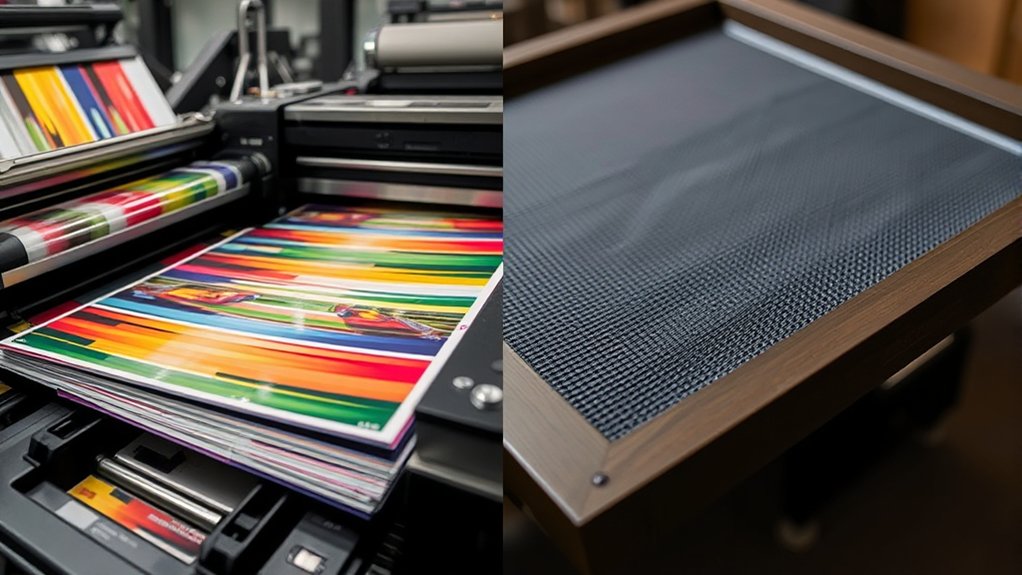

Offset printing vs screen printing each have distinct advantages depending on your project needs.
You’ll find offset printing ideal for high-resolution images on paper with fine color gradients, perfect for large volume jobs thanks to its cost efficiency and sharp detail.
Screen printing stands out for printing on diverse materials like textiles or plastics, offering vibrant, durable colors with fewer layers.
It’s ideal for medium runs and bold designs.
Both have unique strengths in speed, cost, and substrate compatibility—exploring these differences further can help you pinpoint the best fit for your project.
Key Takeaways
- Offset printing delivers high-resolution, sharp images ideal for detailed and large-volume paper printing like magazines and brochures.
- Screen printing excels in printing on textiles and irregular surfaces, providing vibrant colors and durable prints with thicker ink layers.
- Offset printing is cost-effective for large runs due to lower unit costs and faster production speed with longer setup times.
- Screen printing suits medium runs with bold designs, offering superior substrate compatibility but less precise color gradients.
- Choose offset for fine color accuracy and paper substrates; select screen printing for diverse materials and bold, simple color designs.
Offset Vs. Screen Printing: Quick Comparison Overview
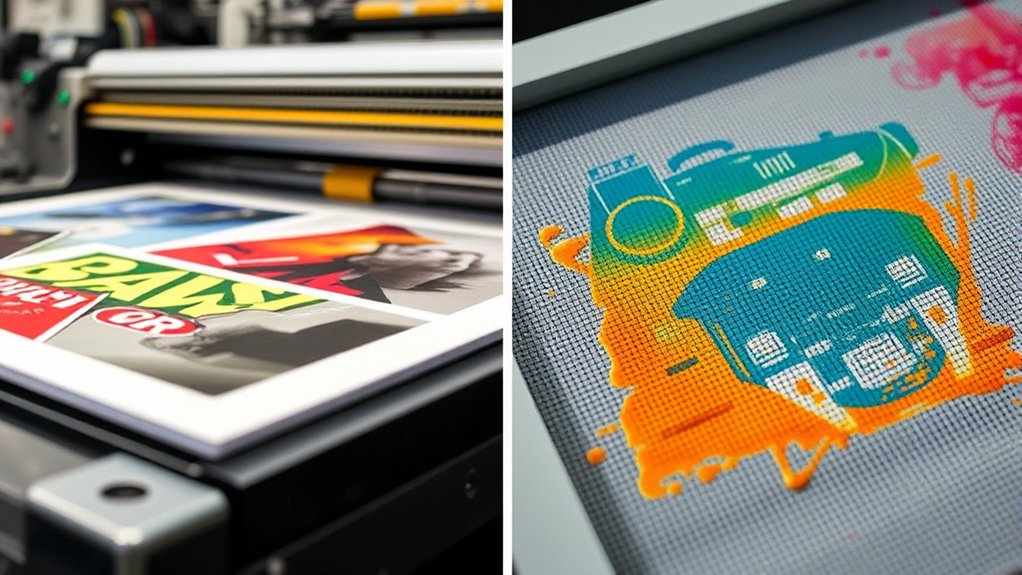
When comparing offset and screen printing, you’ll find five key factors that distinguish these methods: image quality, production speed, cost efficiency, substrate compatibility, and color accuracy. Offset printing excels in high-resolution image quality, making it ideal for detailed print applications such as magazines and brochures.
It operates faster than screen printing when handling large volumes, reducing per-unit cost effectively. Screen printing, while slower, offers superior substrate compatibility, especially with textiles and non-flat surfaces, which digital printing often struggles with.
It also provides vibrant color accuracy for bold designs, especially with thicker ink layers. You’ll notice digital printing bridges some gaps by offering flexible, quick-turnaround jobs but can’t match the cost efficiency or substrate versatility of offset or screen printing in high-volume or specialized applications.
How Offset Printing Works and When to Use It
Offset printing transfers an inked image from a metal plate to a rubber blanket before applying it to the printing surface, ensuring consistent, high-quality results across large runs.
Offset printing uses a metal plate and rubber blanket to deliver sharp, consistent images on large print runs.
In the offset printing process, you start by creating a printing plate, typically aluminum, etched with the desired image. The plate gets dampened with water, which adheres only to non-image areas, repelling ink. Then, ink adheres exclusively to the image areas.
The plate transfers this inked image onto a rubber blanket cylinder, which in turn presses it onto your printing substrate—paper, cardboard, or similar materials.
You should use offset printing when you need sharp, detailed images and consistent color reproduction over thousands of copies. It’s especially ideal for brochures, magazines, and packaging where precision and volume justify the setup of the printing plate.
How Screen Printing Works and When to Choose It
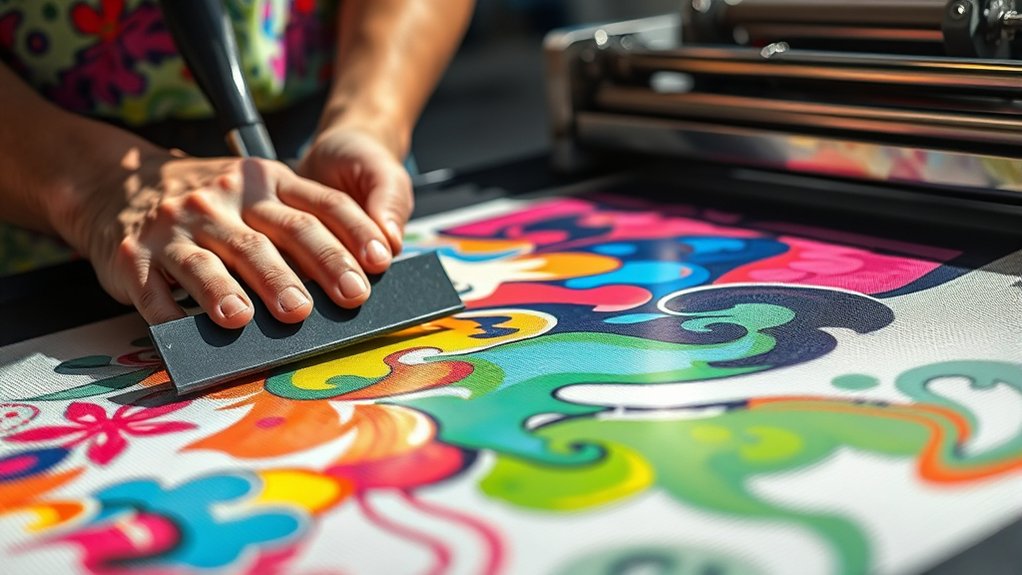
Screen printing applies ink directly onto a substrate through a mesh screen that’s been selectively blocked to create an image. You’ll push ink through unblocked mesh areas, layer by layer, using various screen printing techniques tailored to fabric, paper, or plastic. When deciding to choose screen printing, consider design considerations like color complexity and durability needs.
| Aspect | Details |
|---|---|
| Ink Application | Direct transfer through mesh |
| Suitable Materials | Textiles, plastics, paper |
| Design Complexity | Best for bold, limited colors |
You’ll prefer screen printing for vibrant, durable prints requiring fewer colors and precise layering. Its technique excels when you want long-lasting, tactile results on diverse materials.
Quality, Cost, and Speed: Offset Vs. Screen Printing
Although both printing methods serve distinct purposes, understanding their differences in quality, cost, and speed is essential for selecting the right process. Offset printing excels in color accuracy, delivering sharp, consistent images ideal for detailed graphics on compatible materials like paper and cardboard.
It’s cost-effective for large runs but requires longer setup times. Screen printing offers superior material compatibility, especially on textiles and irregular surfaces, producing vibrant, durable prints. It’s generally faster for short runs but less precise in color gradients.
When considering cost, offset has lower unit costs as volume increases, while screen printing’s costs remain steady regardless of quantity. By evaluating these factors—color accuracy, material compatibility, run length, and turnaround time, you can determine which printing method best fits your project’s technical and budgetary requirements.
How to Choose Between Offset and Screen Printing for Your Project
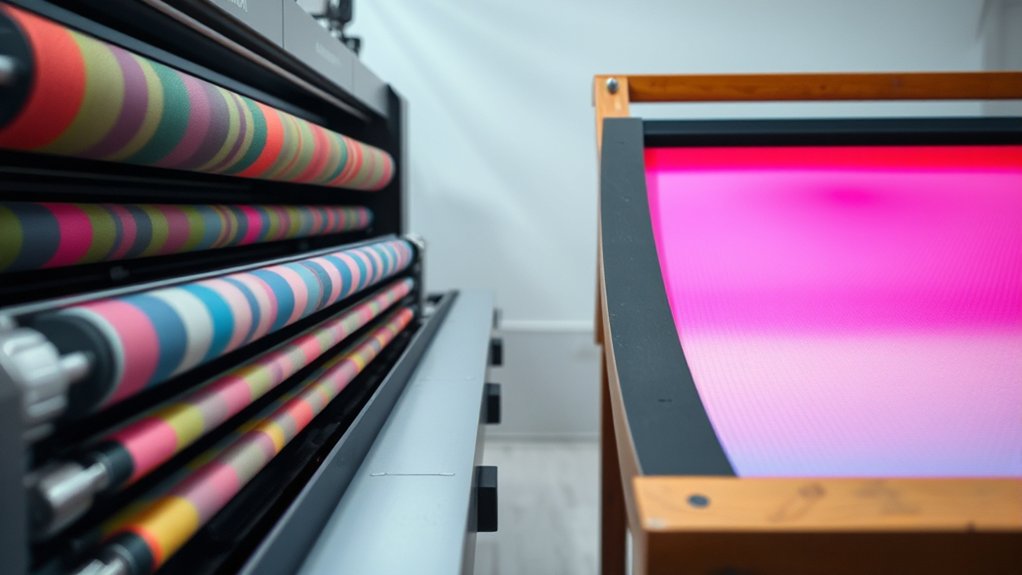
How do you determine the best printing method for your specific project requirements? Start by analyzing the type of print materials involved and the desired output quality.
If you’re working with paper-based materials requiring high-resolution images and subtle color gradients, offset printing excels due to its precise ink distribution and consistent color fidelity. Conversely, if your project demands printing on diverse substrates like textiles, plastics, or metal, screen printing’s versatility and durability make it more suitable.
Consider print volume: offset suits large runs economically, while screen printing is cost-effective for medium runs with bold, solid colors. Evaluate your timeline, as offset printing offers faster turnaround for high quantities.
Frequently Asked Questions
Can Offset and Screen Printing Be Combined in One Project?
You can combine printing techniques like offset and screen printing in one project. This project collaboration enhances visual effects and color vibrancy, but you’ll need precise coordination to guarantee registration accuracy and material compatibility throughout the process.
Which Printing Method Is More Environmentally Friendly?
Imagine a forest sacrificing itself for prints. Screen printing’s eco-friendly inks and sustainable practices reduce waste and chemical use. This makes it more environmentally friendly than offset printing, which relies on heavier solvents and less sustainable materials.
What Are the Storage Requirements for Materials Used in Each Printing Type?
You’ll need cool, dry spaces for ink storage in both methods. Screen printing demands careful material handling to avoid mesh damage.
Offset printing materials require controlled humidity to maintain plate integrity and consistent print quality over time.
How Do Offset and Screen Printing Handle Metallic or Specialty Inks?
You’ll find metallic ink application in offset printing precise but limited, while screen printing offers thicker, more vibrant layers. For specialty ink durability, screen printing excels due to its robust ink deposition and curing methods.
Are There Size Limitations for Prints in Offset vs. Screen Printing?
You’ll find offset printing supports larger print dimensions with excellent print scalability, ideal for extensive runs.
Screen printing handles various sizes but has practical size limits, especially for intricate details and large-scale prints requiring multiple screens.
Conclusion
When deciding between offset and screen printing, remember that “the devil is in the details.” Offset printing excels in high-volume, detailed work with consistent color accuracy, while screen printing offers durability and vibrant colors on varied materials.
Your choice hinges on project specifics like quantity, substrate, and finish quality. By weighing cost, speed, and output demands carefully, you’ll guarantee the printing method perfectly aligns with your technical and budgetary requirements.
In conclusion, understanding the differences between offset printing vs screen printing ensures you select the best process for your unique project needs.