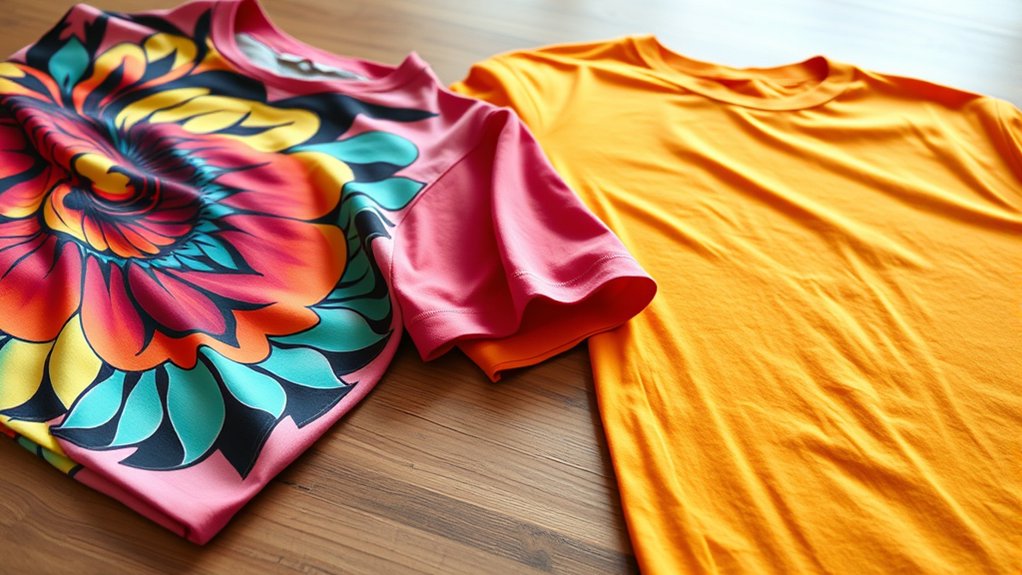

DTG vs Screen Printing are two popular methods for applying designs onto fabrics, each with its own advantages.
DTG printing applies water-based inks directly onto natural fabrics like cotton, making it perfect for intricate, multicolor designs in small batches.
Screen printing uses stencils and durable inks, excelling at high-volume runs with consistent, long-lasting colors, especially on blends or synthetics.
DTG offers vibrant detail but less durability, while screen printing is cost-effective for large orders and more resilient prints.
If you want to understand which method suits your fabric, design, and production needs best, keep exploring the differences.
Key Takeaways
- DTG printing offers superior detail and color vibrancy, ideal for complex, multicolor designs on 100% cotton fabrics.
- Screen printing is more cost-effective for large production runs due to lower per-unit costs after initial setup.
- Screen printing provides greater durability and resistance to fading or cracking after multiple washes compared to DTG.
- DTG requires minimal setup and is best suited for small batches with frequent design changes.
- Screen printing works well on cotton/poly blends and synthetics, offering consistent color vibrancy across various fabrics.
What Is DTG Printing and How It Works
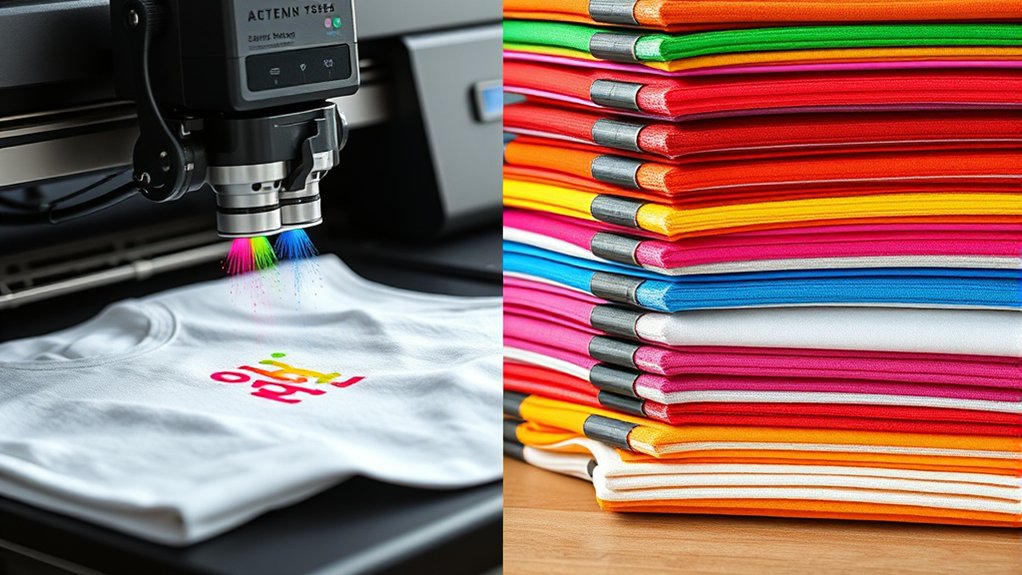
Direct-to-Garment (DTG) printing uses specialized inkjet technology to apply water-based inks directly onto fabric. You’ll find that recent DTG technology advancements have improved print resolution and color vibrancy, enabling more detailed, full-color designs without the need for screens or plates.
When you use DTG, the ink penetrates the fibers, resulting in a soft, breathable finish. However, you should be aware of DTG design limitations, such as its reduced effectiveness on dark fabrics without a white underbase and slower production speeds compared to other methods.
Additionally, DTG works best with 100% cotton materials, as synthetic blends can affect ink absorption. Understanding these technical aspects helps you optimize your design choices and production workflow with DTG printing.
How Screen Printing Works
You start screen printing by preparing a stencil that blocks out areas where ink shouldn’t pass through. Then, you apply ink using a squeegee that presses it evenly across the screen mesh onto the fabric.
The process relies on specialized equipment designed to hold the screen tightly and guarantee accurate ink transfer.
Stencil Preparation Process
Although screen printing involves multiple steps, the stencil preparation process is essential for achieving precise designs. You begin by selecting the appropriate stencil type, commonly photo emulsion or capillary film, based on your design complexity and substrate.
You then coat the screen evenly with the emulsion in a light-controlled environment to avoid premature exposure. After drying, you expose the screen to UV light through a film positive, hardening the emulsion except where the design blocks the light. This creates a precise stencil that defines ink passage areas.
Finally, you wash out the unexposed emulsion to reveal the open mesh areas. Different stencil applications demand varying exposure times and emulsion thicknesses, so calibrate accordingly to guarantee sharp edges and durability throughout multiple print runs.
Ink Application Techniques
Once the stencil is prepared, the ink application stage begins by placing the screen tightly against the substrate. You then use a squeegee to push ink across the screen, forcing it through the open areas of the stencil.
Controlling ink viscosity is critical here; too thick, and it won’t pass smoothly, reducing print resolution. Too thin, and it can bleed, compromising detail. The squeegee pressure and angle also affect ink deposit and sharpness.
This direct contact guarantees precise ink placement, essential for high-quality outcomes. Each pass adds layers, so consistent technique maintains uniformity. The interplay between ink viscosity and screen mesh tension governs how finely you can reproduce intricate designs, directly impacting the print resolution. Mastering these variables lets you achieve sharp, vibrant prints characteristic of screen printing.
Screen Printing Equipment
Mastering ink application depends heavily on the right tools, which brings us to the core components of screen printing equipment. You’ll primarily work with screen printing machines that hold the mesh screen tightly and allow precise ink deposition.
These machines range from manual to automatic, each offering varying speeds and control levels. Alongside, you need quality screen printing supplies such as squeegees, emulsions, and inks.
The squeegee pushes ink through the mesh onto your substrate, demanding consistent pressure and angle for sharp prints. Emulsions create the stencil on the screen, defining your design’s detail and durability.
Proper maintenance of both machines and supplies guarantees crisp, repeatable results. Understanding each component’s role allows you to optimize production efficiency and print quality in your screen printing process.
Cost and Order Size Comparison: DTG vs Screen Printing
You’ll notice that DTG’s initial setup costs are lower but become less cost-efficient as order size grows, while screen printing requires higher upfront investment but reduces per-unit costs considerably with larger runs.
Understanding these cost dynamics helps you determine the ideal order quantity for each method. Let’s break down how setup expenses and scale impact your overall production budget.
Initial Setup Costs
Comparing initial setup costs between DTG and screen printing reveals distinct financial commitments that impact order size decisions. You’ll find DTG requires a higher upfront investment in specialized printers, while screen printing demands expenses for screens and setup labor. This initial setup cost analysis helps you determine the most cost-effective method based on your production volume.
| Setup Element | Approximate Cost |
|---|---|
| DTG Printer | $10,000 – $30,000 |
| Screen Preparation | $200 – $500 per design |
| Equipment & Inks | $1,000 – $3,000 |
For smaller batches, DTG’s fixed printer cost is justified. In contrast, screen printing’s per-design setup fees make it ideal for larger runs where costs amortize over volume.
Cost Efficiency Per Unit
Although DTG involves a higher initial investment, it often delivers lower per-unit costs for small to medium order sizes due to minimal setup requirements. You avoid expensive screen creation and lengthy preparation, which keeps costs steady regardless of design complexity.
Screen printing, however, benefits from bulk discounts as the fixed setup costs spread across large volumes, greatly lowering per-unit prices. Its faster production speed for high volumes makes it cost-effective when you order in bulk.
Conversely, DTG’s production speed suits short runs but slows down as quantity grows, increasing labor costs. So, if you prioritize flexibility and quick turnaround for moderate quantities, DTG is efficient. But for large orders demanding rapid output and cost savings, screen printing offers superior cost efficiency per unit.
Ideal Order Quantities
Many small to medium-sized orders align well with DTG printing due to its minimal setup and ability to handle complex designs without additional cost. You won’t face minimum quantities, allowing flexibility for limited runs or custom pieces.
However, screen printing becomes more cost-effective as order size increases, thanks to bulk discounts that greatly reduce per-unit cost beyond minimum quantities. While screen printing requires upfront setup like screens and color separations, these fixed costs spread out over large batches, making it ideal for high-volume orders.
When deciding, consider your order size: choose DTG for quantities below 50 or intricate artwork, and opt for screen printing when ordering 100+ units to leverage bulk discounts and lower unit costs. This guarantees the best balance between cost and production efficiency.
Best Fabrics and Designs for DTG and Screen Printing
When selecting fabrics for DTG and screen printing, understanding their distinct requirements guarantees ideal results. DTG excels on natural fabric types like 100% cotton, accommodating high design complexity with smooth gradients. Screen printing, however, favors blends or synthetics for durability and vibrancy but handles simpler, bold designs better.
| Fabric Types | DTG Suitability | Screen Printing Suitability |
|---|---|---|
| 100% Cotton | Excellent | Good |
| Cotton/Poly Blend | Moderate | Excellent |
| Synthetic Fabrics | Poor | Good |
| Fabric Weight | Medium to Light | Medium to Heavy |
Choose DTG for detailed, multicolor images on soft fabrics. Opt for screen printing for bold designs on varied fabric types.
When to Choose DTG vs Screen Printing for Your Project
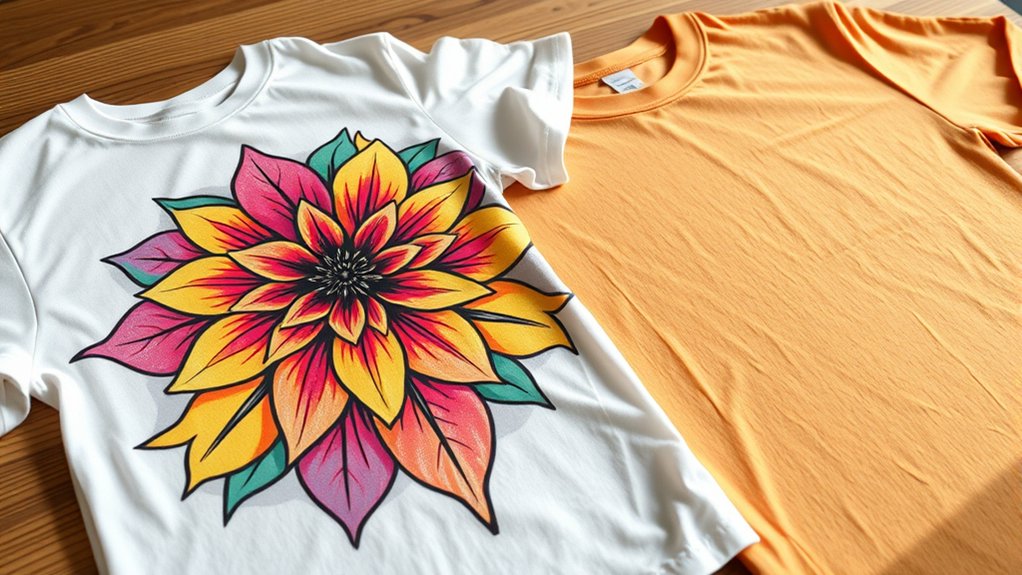
For projects requiring intricate, multicolor designs on soft, natural fabrics, DTG offers unmatched precision and color depth. You should choose DTG when your design preferences include high-detail gradients or photographic elements. It’s ideal for small to medium production runs, as setup is minimal and allows for fast adjustments.
Conversely, screen printing excels when you need large quantities with limited colors, thanks to its cost-efficiency over high volumes. If your production timelines are tight, and you’re producing thousands of identical prints, screen printing typically delivers faster batch processing once screens are prepared.
Consider DTG for flexibility and complexity, and screen printing for consistency and speed on bulk orders. Align your choice with your design preferences and production timelines to optimize cost, quality, and turnaround.
Durability and Color Quality: DTG vs Screen Printing
Although DTG printing delivers vibrant, high-resolution colors with smooth gradients, its durability typically falls short compared to screen printing. When you evaluate ink longevity, screen printing uses plastisol or solvent-based inks that penetrate fabric fibers deeply, resulting in prints that resist cracking and fading over numerous washes.
Conversely, DTG relies on water-based inks that sit on the fabric surface, which can diminish color vibrancy after repeated laundering. However, DTG excels in producing detailed, photo-quality images with a broader color spectrum, ideal for complex designs.
If your priority is long-lasting prints with consistent color vibrancy under heavy wear, screen printing is the superior choice. But if you require fine detail and gradient effects for short to medium-term use, DTG offers unmatched precision despite its limited ink longevity.
Frequently Asked Questions
Can DTG Printing Be Used on Dark Fabrics Without a White Base?
No, you can’t use DTG printing on dark fabrics without a white base because dark fabric challenges dull DTG color vibrancy.
The white underbase guarantees colors stay vivid and accurate, overcoming fabric darkness interference effectively.
How Environmentally Friendly Is Screen Printing Compared to DTG?
Don’t assume screen printing’s less eco friendly; it often uses sustainable materials and eco friendly practices like water-based inks and reusable screens. You’ll find it can reduce waste, making it a strong sustainable choice compared to DTG.
What Are the Typical Turnaround Times for DTG Vs Screen Printing?
You’ll find DTG turnaround times quicker for small orders due to faster production speed. Screen printing requires longer setup but excels in high-volume jobs, offering reduced turnaround times and cost efficiency as quantities increase.
Can Screen Printing Handle Detailed Photographic Images Effectively?
You won’t get photographic clarity with screen printing like DTG offers; it struggles with detail preservation, especially in fine gradients.
Screen printing excels in bold colors but can’t replicate detailed photographic images effectively for your needs.
Are There Any Limitations on Ink Types for DTG Printing?
You’ll find DTG ink compatibility limited to water-based inks, which affects print durability on certain fabrics. Synthetic materials can reduce adhesion, so choosing compatible textiles is essential for maintaining long-lasting, vibrant prints with DTG technology.
Conclusion
Now that you’ve seen how DTG and screen printing differ in cost, fabric compatibility, and durability, which method will you choose? Each has its strengths—DTG excels in intricate, small runs, while screen printing dominates large orders with vibrant, lasting prints.
The decision hinges on your project’s specifics. But before you decide, consider the hidden factors like ink longevity and fabric feel.
Ready to make the smartest, most efficient choice? When it comes down to dtg vs screen printing, understanding these nuances will help you pick the best technique for your needs.