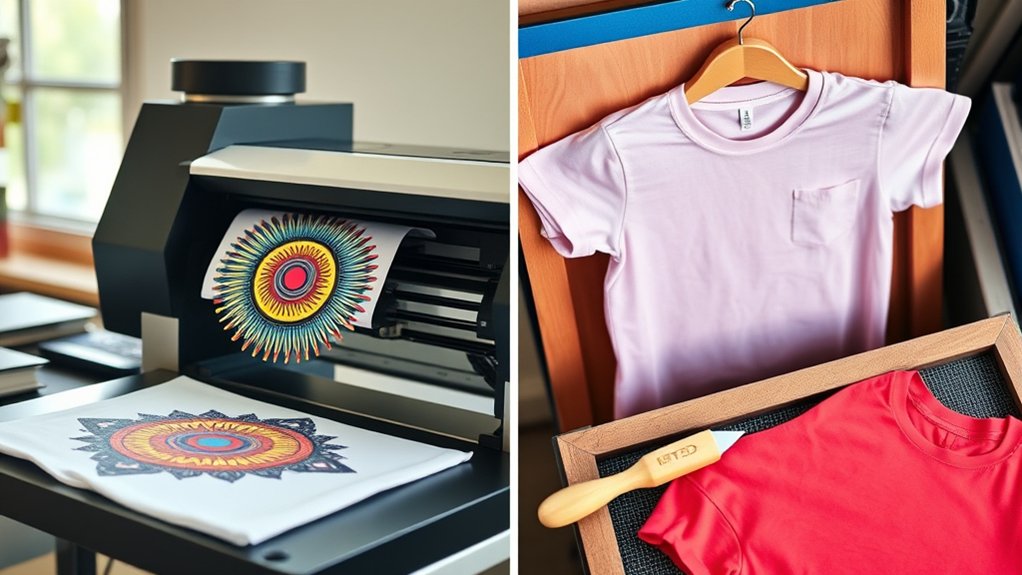

Direct to Garment Printing Vs Screen Printing are two popular methods for customizing apparel, each with its own strengths.
If you need detailed, full-color prints on natural fabrics like cotton with soft gradients, direct-to-garment (DTG) printing is your go-to for small or custom orders, thanks to minimal setup.
For bold, vibrant colors and durable prints on larger runs across various fabrics, screen printing excels. However, it requires more setup and works best with fewer colors.
Understanding cost, quality, and fabric compatibility will help you make the best choice for your apparel project.
Key Takeaways
- DTG printing uses inkjet technology for detailed, full-color designs with minimal setup, ideal for small or custom orders.
- Screen printing applies thicker ink layers via stencils, creating vibrant, saturated colors best suited for larger runs.
- Screen printing offers greater durability and resistance to fading compared to DTG, which requires careful curing for longevity.
- DTG is cost-effective for small quantities due to no setup fees, while screen printing is cheaper per piece for large orders.
- DTG works best on natural fabrics with complex designs, whereas screen printing suits simpler color palettes and diverse fabric types.
What Is Direct to Garment (DTG) Printing?
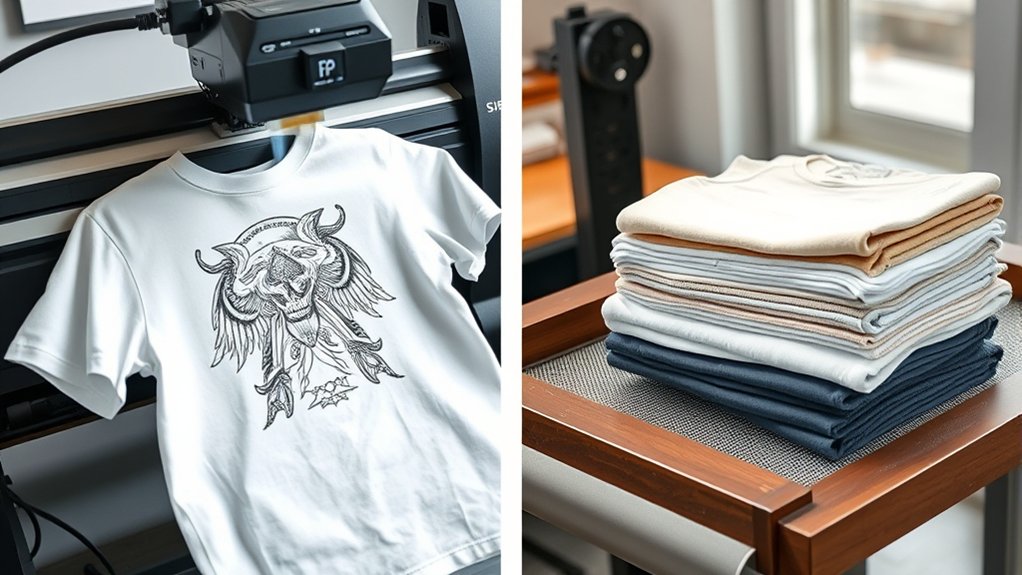
Although you might be familiar with traditional printing methods, Direct to Garment (DTG) printing offers a modern approach that prints designs directly onto fabric using specialized inkjet technology. DTG technology employs advanced print heads that apply water-based inks precisely onto textiles, allowing complex, full-color images with fine detail.
This process requires pre-treatment of garments to guarantee ink adhesion and color vibrancy. You’ll find DTG printing ideal for small-batch or custom printing applications due to its minimal setup time and ability to reproduce intricate designs without screens or plates.
Its digital workflow supports rapid design changes, making it highly versatile for on-demand production. Understanding DTG technology’s mechanics helps you appreciate how it streamlines printing applications compared to traditional methods.
How Does Screen Printing Work?
When you choose screen printing, you rely on a stencil-based technique where ink is pushed through a mesh screen onto the fabric, layer by layer. Each color requires a separate screen, making precise alignment essential.
You’ll select ink types, such as plastisol, water-based, or discharge, based on fabric and desired finish. The process involves coating a screen with emulsion, exposing it to light to create the stencil, then applying ink with a squeegee.
This method suits bulk orders due to setup time but delivers vibrant, durable prints.
| Step | Description | Ink Types Used |
|---|---|---|
| Preparation | Coating screen with emulsion | Water-based, Plastisol |
| Exposure | Light hardens stencil area | Discharge |
| Printing | Ink pushed through mesh | Plastisol, Water-based |
| Curing | Heat sets ink | All ink types |
DTG vs Screen Printing: Which Offers Better Print Quality and Durability?
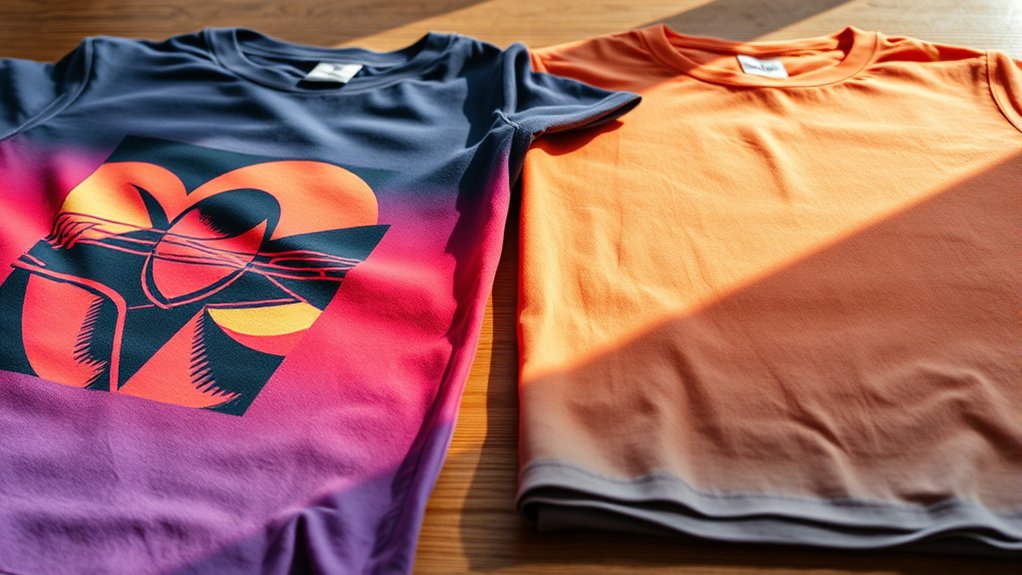
When comparing DTG and screen printing, you’ll notice distinct differences in print detail and color vibrancy that impact overall quality. DTG excels at capturing intricate designs with smooth gradients, while screen printing delivers bolder, more saturated colors.
You’ll also want to take into account durability, as screen prints generally withstand washing and wear better over time.
Print Detail Comparison
Since print quality and durability are critical factors in choosing between Direct to Garment (DTG) and screen printing, understanding their technical differences is essential. DTG excels in print resolution due to its inkjet technology, allowing intricate designs with smooth gradients.
The ink quality in DTG is water-based, offering softness but less resistance to frequent washing. Screen printing uses thicker, plastisol inks that provide superior durability and vibrant prints but may lack the fine detail DTG achieves.
Consider these points:
- DTG supports high print resolution suitable for complex artwork.
- Screen printing delivers robust ink layers enhancing longevity.
- Ink quality impacts color retention and fabric feel.
- Durability favors screen printing, especially for heavy wash cycles.
You must weigh detail precision against long-term wear when deciding.
Color Vibrancy Differences
Beyond print detail and durability, color vibrancy plays a significant role in determining the overall print quality between Direct to Garment (DTG) and screen printing. You’ll notice screen printing typically achieves higher color saturation due to thicker ink layers and limited ink absorption by fabric.
DTG, however, offers subtler hues with more ink absorption, affecting vibrancy but allowing smoother gradients.
| Aspect | DTG Printing | Screen Printing |
|---|---|---|
| Color Saturation | Moderate, affected by ink absorption | High, thick ink layers |
| Ink Absorption | High, ink penetrates fibers | Low, ink sits on surface |
| Vibrancy | Softer, ideal for complex designs | Bold, vibrant, solid colors |
You should choose based on your need for vibrancy or detail.
Durability Over Time
Although both Direct to Garment (DTG) and screen printing produce high-quality prints, their durability varies considerably due to differences in ink composition and application methods. You’ll find that screen printing generally offers superior ink adherence, especially on a wide range of fabric types, enhancing long-term durability.
DTG excels on cotton blends but may falter on synthetic fabrics due to limited fabric compatibility.
Consider these factors when evaluating durability over time:
- Screen printing uses thicker ink layers, resisting fading and cracking longer.
- DTG inks penetrate fibers, offering softness but potentially less abrasion resistance.
- Fabric compatibility affects how well ink bonds and withstands washing cycles.
- Proper curing in both methods is critical to maximize print lifespan.
Ultimately, your choice hinges on the fabric involved and expected wear conditions.
Comparing Costs: DTG and Screen Printing for Small and Large Orders
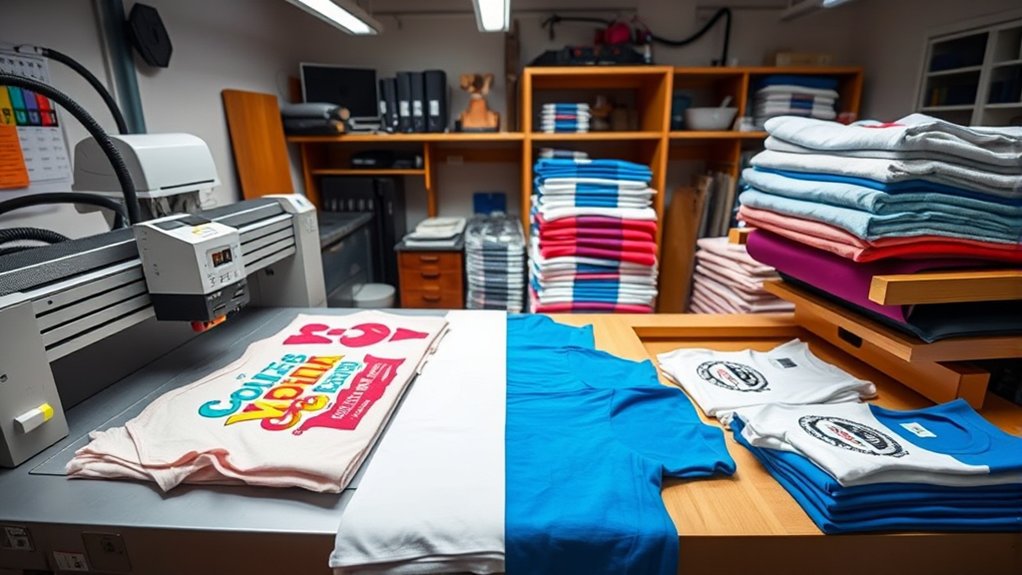
When handling small orders, you’ll find DTG printing more cost-effective since it eliminates setup fees typical of screen printing.
For large orders, screen printing reduces the per-unit cost considerably due to economies of scale despite higher initial setup costs. Understanding these cost dynamics helps you choose the best method for your order size.
Small Order Cost Efficiency
Since small orders demand minimal setup, direct to garment (DTG) printing often proves more cost-effective than screen printing. When you handle a small batch, DTG eliminates the need for screen preparation, reducing upfront costs considerably.
Screen printing, conversely, incurs fixed setup fees that make small runs less economical until you reach bulk savings thresholds.
Consider these factors for small order cost efficiency:
- No screen setup or cleaning required in DTG
- Per-unit cost remains stable regardless of quantity in DTG
- Screen printing setup fees disproportionately impact small batches
- Screen printing becomes cost-efficient only after achieving bulk savings
Large Order Price Breakdown
As your order size grows, you’ll notice the cost dynamics between direct to garment (DTG) and screen printing shift considerably. Screen printing becomes more cost-effective at higher order quantities due to significant bulk discounts and economies of scale.
The initial setup costs, such as screen preparation and color separation, are spread over large volumes, reducing the per-unit price dramatically. DTG, however, maintains relatively consistent costs per piece because it prints each item individually without setup fees.
While DTG offers flexibility for complex, multi-color designs, its lack of bulk discounts makes it less competitive for large orders. When evaluating large order price breakdowns, focus on how order quantities influence cost efficiency: screen printing thrives with volume, while DTG suits smaller runs or intricate artwork without setup overhead.
Production Times and Setup: How They Affect Your Printing Choice
How quickly you need your printed items can greatly influence whether you choose direct to garment (DTG) or screen printing. DTG offers faster production timelines because it requires minimal setup complexity. It is ideal for small batches or rush orders.
Screen printing, however, involves a detailed setup process, including creating screens for each color, which extends lead times but becomes more efficient for large runs.
Consider these factors when deciding:
- DTG requires little setup, enabling rapid turnaround.
- Screen printing demands extensive setup, increasing initial production time.
- Bulk orders benefit from screen printing’s efficiency after setup.
- Complex designs with multiple colors increase screen printing setup complexity.
Best Fabrics and Projects for DTG and Screen Printing
When selecting the best fabrics and projects for DTG and screen printing, you need to match each method’s technical strengths to your material and design requirements. DTG excels on natural fiber fabric types like 100% cotton, delivering high-resolution prints ideal for detailed, multi-color designs. It suits small runs or custom projects where color gradients and complex imagery matter.
Screen printing, however, performs best on a wider range of fabric types, including cotton blends and synthetics, due to its durable ink application. It’s ideal for larger projects with limited colors, such as logos or bold graphics, where longevity and cost-efficiency at scale are priorities. Understanding these distinctions guarantees you select the correct printing method based on your project suitability and fabric compatibility.
How to Choose Between DTG and Screen Printing for Your Apparel Needs
Deciding between DTG and screen printing depends largely on your project’s complexity, volume, and fabric choice. You’ll want to evaluate how each printing technique aligns with your design preferences and production needs. DTG excels with intricate, colorful designs on small runs, while screen printing is cost-effective for large volumes with simpler color palettes.
Evaluate these factors to choose the best method:
- Design complexity: DTG handles detailed gradients better; screen printing suits bold, solid colors.
- Order size: Screen printing reduces per-unit cost in bulk; DTG is ideal for low quantities.
- Fabric type: DTG works best on 100% cotton; screen printing adapts well to various blends.
- Durability needs: Screen prints generally offer longer-lasting wear.
Frequently Asked Questions
Can DTG Printing Be Used on Dark Fabrics Without a White Base?
You can’t effectively use DTG printing on dark fabric without a white base because ink opacity is low. The white underbase guarantees colors show vividly and maintains dark fabric compatibility by preventing color bleeding and dull prints.
Is Screen Printing Environmentally Friendly Compared to DTG?
You’ll find screen printing uses up to 70% less water than DTG, making it more environmentally friendly when paired with sustainable practices and eco-friendly ink materials. This approach reduces waste and chemical runoff effectively.
What Are the Maintenance Requirements for DTG Printers?
You’ll perform daily print head cleaning and ink system checks to prevent clogs. Regularly inspect and replace wiper blades. Although printer upkeep demands time, maintenance costs remain moderate, balancing downtime with sustained print quality and machine longevity.
How Do DTG and Screen Printing Affect Garment Breathability?
Ironically, a thick screen print might feel like wearing a plastic shield, limiting breathability factors. You’ll find DTG’s finer ink application better preserves fabric choices’ airflow, ensuring garments stay more breathable and comfortable overall.
Are There Color Limitations With DTG or Screen Printing?
You’ll find DTG offers unlimited color vibrancy but slower production speed, while screen printing limits colors per design yet achieves brighter hues and faster runs. Choose based on your color complexity and timing needs.
Conclusion
Choosing between DTG and screen printing is like picking the right tool for a precise job. DTG excels in detailed, small-batch prints with quick turnaround, while screen printing shines in durability and cost-efficiency for large runs.
Consider your project’s scale, fabric, and quality needs carefully. Each method has its strengths depending on the design complexity and quantity required.
By understanding these technical differences, you’ll make an informed decision that guarantees your designs not only look sharp but also stand the test of time. When deciding between direct to garment printing vs screen printing, matching the method to your specific needs is key to achieving the best results.