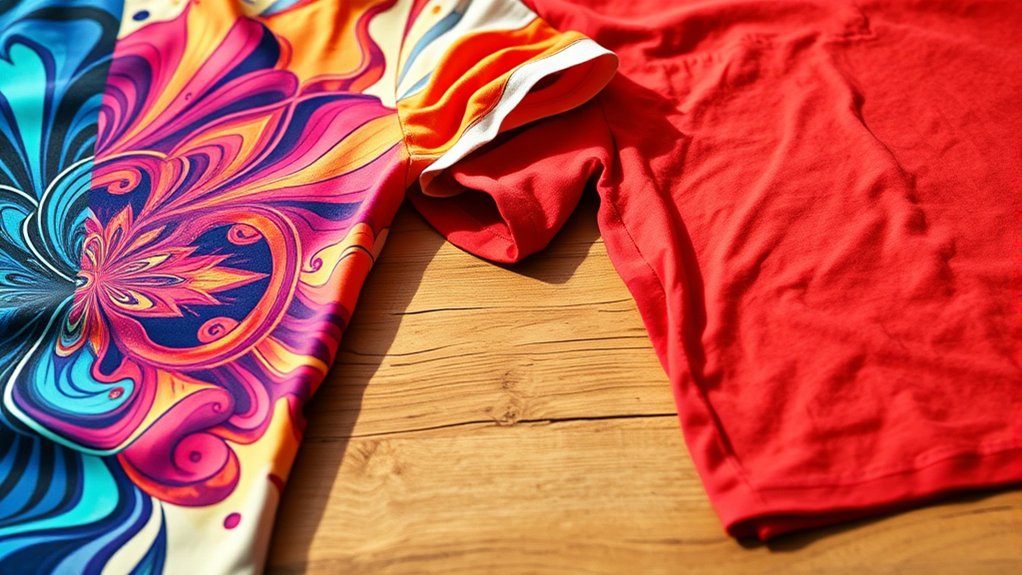

Digital Fusion vs Screen Printing are two popular methods for customizing fabrics, each with its strengths.
If your design demands high-resolution detail and vibrant, full-color gradients on polyester, Digital Fusion is your best bet for small to medium runs with quick turnaround and minimal waste.
For bold, flat colors, superior weather resistance, and cost-efficiency in large volume orders on cotton blends, Screen Printing prevails.
Each method suits specific fabrics and production sizes, so knowing these nuances guarantees peak quality and durability.
Exploring these key differences further can clarify the ideal choice for your project.
Understanding when to use Digital Fusion versus Screen Printing ensures the best results for your design needs.
Key Takeaways
- Digital Fusion offers high-resolution, full-color prints ideal for intricate, multi-color designs with rapid customization and minimal setup waste.
- Screen Printing excels in bold, flat colors and is cost-effective for large volume orders with simpler designs and fewer colors.
- Digital Fusion is best suited for polyester and synthetic fabrics, while Screen Printing performs well on cotton and natural fabric blends.
- Screen Printing provides superior durability, weather resistance, and wash resistance, making it ideal for long-lasting prints.
- Digital Fusion has lower setup costs and is more efficient for small to medium runs, whereas Screen Printing is more economical for bulk production.
Digital Fusion Vs Screen Printing: Key Differences at a Glance
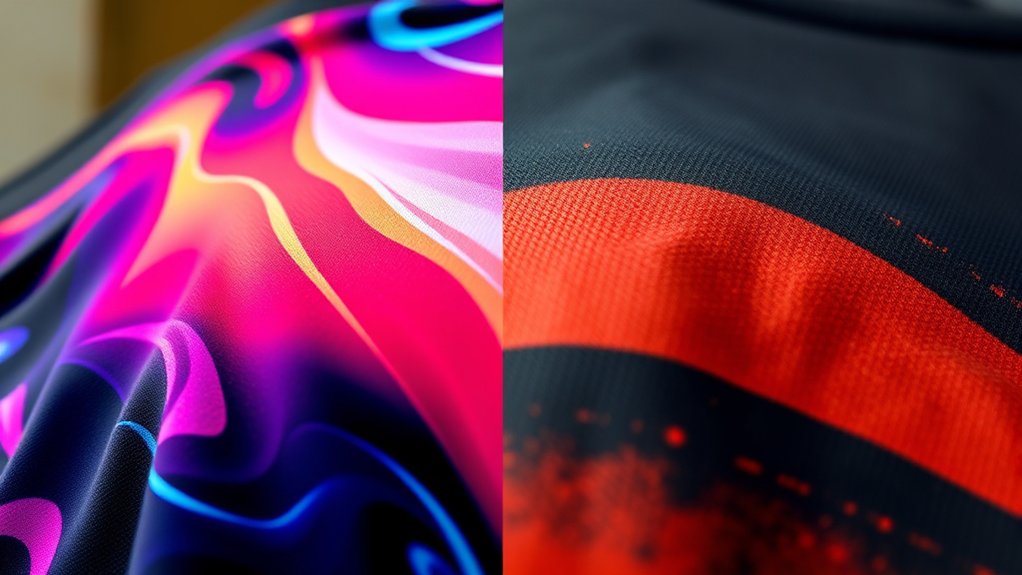
Although both Digital Fusion and Screen Printing serve the purpose of transferring designs onto fabrics, they differ considerably in process, cost, and application. You’ll notice that Digital Fusion leverages advanced printing innovations, enabling precise, full-color reproductions with minimal setup.
It suits complex design trends requiring gradient and photographic detail. Conversely, Screen Printing uses stencils and ink layers, excelling in bold, flat colors and large volume runs. It demands higher initial setup costs but reduces unit price with scale.
When evaluating both methods, consider your design complexity, budget constraints, and production volume. Digital Fusion offers flexibility and quick turnaround for smaller batches, while Screen Printing remains economical for mass production with simpler designs.
Understanding these differences helps you choose the best technique aligned with your project’s technical and aesthetic needs.
Digital Fusion Printing: Process and Benefits
You’ll start by applying specialized inks directly to the fabric using advanced digital printheads, ensuring precise color placement and detail. This process reduces setup time and waste compared to traditional methods, allowing for rapid customization and small runs.
Understanding these advantages helps you optimize production efficiency and achieve high-quality, durable prints.
Digital Fusion Technique Overview
Digital Fusion printing combines precision inkjet technology with advanced heat-pressing methods to create durable, high-resolution designs directly on fabric. You start by digitally printing the image onto a specialized transfer paper using high-quality inks.
Next, you position the paper on the fabric and apply heat and pressure through a heat press. This process fuses the ink into the fabric fibers, ensuring strong adhesion and vibrant colors.
The digital fusion technique offers exceptional design flexibility, allowing you to reproduce intricate details and gradients without the constraints of traditional screens. Because it’s a direct-to-transfer process, you can easily customize each print without setup delays.
This method supports small runs or one-offs efficiently, making it ideal for personalized or complex designs that require precise color matching and sharp resolution.
Advantages Of Digital Fusion
The precision inkjet and heat-press fusion methods deliver several key advantages that make this technique stand out. You gain exceptional design flexibility, allowing intricate, multi-color graphics without additional setup costs.
Digital Fusion precisely deposits ink, ensuring sharp detail and consistent quality across complex patterns. This method considerably reduces environmental impact by minimizing ink waste and eliminating the need for water-intensive processes typical of screen printing.
Additionally, the fusion process bonds inks directly to fibers, enhancing durability without compromising fabric feel. Because you bypass screens, you can quickly switch designs, supporting short runs and rapid prototyping efficiently.
Traditional Screen Printing: Features and Advantages
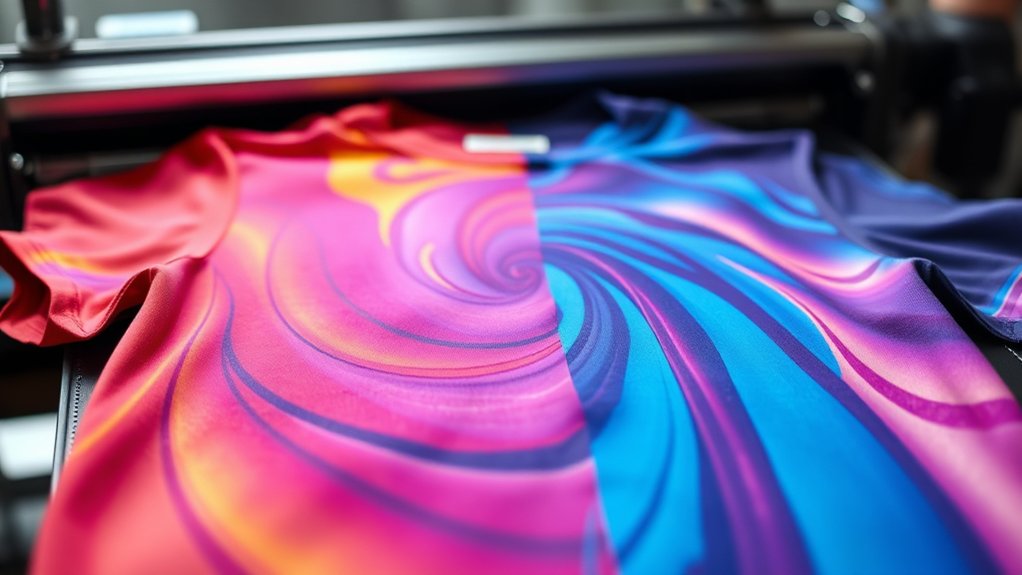
When you choose traditional screen printing, you get prints known for their durability and long-lasting quality. The method produces vibrant color output by applying thick layers of ink, ensuring strong visual impact.
Additionally, it’s cost-effective for bulk orders since the setup spreads fixed costs over large quantities.
Durability and Longevity
Although other methods exist, traditional screen printing stands out for its exceptional durability and longevity. You’ll find it excels in weather resistance, allowing prints to withstand harsh conditions without significant fading or cracking.
Its compatibility with diverse fabrics guarantees the print adheres deeply, which enhances wear resistance and lifespan. This technique’s thick ink layers contribute to robust, long-lasting designs, especially on cotton, polyester, and blends.
| Feature | Benefit |
|---|---|
| Weather Resistance | Maintains print integrity outdoors |
| Fabric Compatibility | Works well on multiple fabric types |
| Ink Thickness | Enhances longevity of print |
| Wash Fastness | Resists fading after many washes |
| Crack Resistance | Prevents print deterioration |
You can rely on traditional screen printing for durable, high-quality prints that endure over time.
Vibrant Color Output
Vibrant color output defines traditional screen printing’s appeal, delivering intense hues that stand out vividly on fabric. You benefit from superior color vibrancy because screen printing uses thick layers of ink, which saturate the fabric deeply and uniformly.
This technique maximizes color saturation, ensuring the printed image maintains brightness even after multiple washes. Unlike some digital methods, screen printing’s inks are opaque and dense, allowing colors to pop on both light and dark textiles.
When precise color matching is critical, you can rely on Pantone inks for consistent, repeatable results. Additionally, the layering process lets you build complex, multi-color designs without compromising color intensity.
Cost-Effectiveness for Bulk
Because traditional screen printing spreads setup costs over large orders, it becomes exceptionally cost-effective for bulk production. When you increase order quantities, the upfront expenses, such as screen preparation and stencil creation, are amortized across more units, reducing the cost per item considerably.
This scaling effect enables competitive bulk pricing that digital methods struggle to match. Additionally, screen printing’s fixed setup costs remain constant regardless of volume, so the marginal cost of producing each additional unit decreases sharply.
If you’re planning high-volume runs, screen printing optimizes your budget by lowering unit costs as order quantities rise. You’ll benefit from predictable pricing structures and enhanced cost efficiency, making traditional screen printing a preferred choice for large-scale projects where minimizing per-unit expenditure is critical.
Print Quality and Detail: Digital Fusion Vs Screen Printing
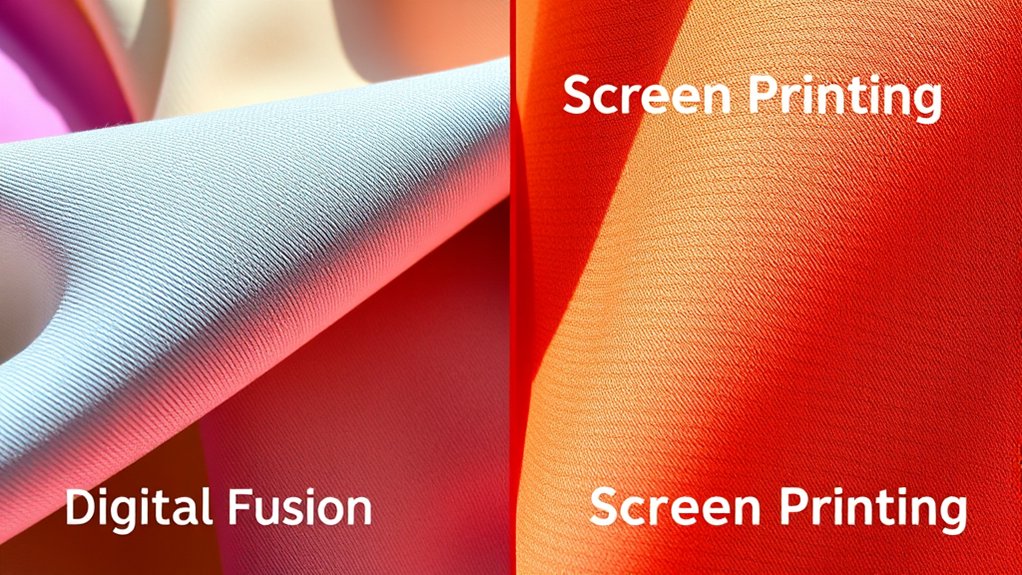
When comparing print quality and detail, Digital Fusion offers high-resolution capabilities that capture intricate designs with smooth gradients and fine lines. You’ll notice its superior print resolution guarantees crisp edges and excellent color saturation, making complex artwork stand out vividly. Screen printing, while robust, tends to deliver less detail in small elements due to mesh limitations.
Consider these points:
- Digital Fusion’s print resolution often exceeds 1200 dpi, enhancing fine detail.
- Color saturation in Digital Fusion remains consistent across gradients.
- Screen printing excels in bold, solid colors but struggles with subtle shading.
- Fine lines and gradients are better preserved in Digital Fusion prints.
You’ll find Digital Fusion ideal for detailed, multicolor designs, while screen printing suits simpler motifs with solid color blocks.
Cost Comparison: Digital Fusion Vs Screen Printing
Cost efficiency plays a crucial role in choosing between Digital Fusion and screen printing. Conducting a thorough cost analysis reveals that screen printing offers lower per-unit prices for large runs due to economies of scale but incurs higher setup costs.
Digital Fusion, by contrast, has minimal setup expenses, making it more cost-effective for small to medium runs or designs with multiple colors without increasing costs. Pricing trends show that Digital Fusion’s upfront costs remain stable regardless of volume, while screen printing’s total cost decreases as quantity increases.
If you prioritize short runs or frequent design changes, Digital Fusion minimizes waste and setup fees. For high-volume orders, screen printing typically delivers better cost efficiency, provided you can absorb the initial setup investment.
Durability and Longevity: Digital Fusion Vs Screen Printing
Durability determines how well your prints withstand wear, washing, and environmental exposure over time. When comparing Digital Fusion and Screen Printing, consider these critical factors:
- Color Fading: Screen printing uses thick ink layers, reducing color fading, while Digital Fusion’s dye-sublimation may fade faster on incompatible fabrics.
- Fabric Compatibility: Screen printing adapts to diverse fabrics, including cotton and blends. Digital Fusion excels on polyester but struggles with natural fibers.
- Wash Resistance: Screen printing’s cured inks resist multiple washes better; Digital Fusion’s bond depends on fabric type and curing quality.
- Environmental Exposure: Screen prints maintain integrity under UV and moisture; Digital Fusion may degrade quicker outdoors.
Understanding these points helps you select a method that matches your durability needs and fabric compatibility requirements precisely.
Best Use Cases and How to Choose the Right Printing Method
Although both Digital Fusion and Screen Printing offer distinct advantages, selecting the right method depends on your project’s specific requirements such as fabric type, design complexity, production volume, and intended usage. For intricate designs with multiple colors and gradients, Digital Fusion excels due to its precision and no setup limitations.
Conversely, Screen Printing is ideal for high-volume runs with fewer colors, ensuring cost-efficiency and vibrant, durable results. Consider material compatibility: Digital Fusion works best on polyester and synthetic blends, while Screen Printing suits cotton and natural fabrics.
Evaluate design considerations like color count and detail to avoid quality loss. Ultimately, weigh production scale, fabric choice, and design complexity to choose the best printing method that balances performance, cost, and durability for your project.
Frequently Asked Questions
Can Digital Fusion Printing Be Used on All Fabric Types?
You can’t use digital fusion printing on all fabric types due to fabric compatibility limits. This printing technique works best on synthetic or polyester blends, so natural fibers may not absorb ink effectively or provide durable results.
Is Screen Printing Eco-Friendly Compared to Digital Fusion?
You’ll find screen printing less eco-friendly; it uses water-based or plastisol inks, which impact sustainability practices differently.
Though water-based inks reduce toxins, their water consumption and waste make digital fusion generally greener overall.
How Long Does the Setup Process Take for Each Method?
You’ll find screen printing setup efficiency lower, taking hours to prepare screens, while digital fusion offers faster setup.
Production speed favors digital fusion for small batches, but screen printing excels with high-volume runs once setup’s complete.
Are There Color Limitations in Digital Fusion Printing?
When it comes to color vibrancy, digital fusion doesn’t miss a beat; you won’t find many color limitations. Its printing accuracy lets you reproduce intricate designs with sharp, vibrant hues, making your prints pop every single time.
Can Screen Printing Accommodate Complex Image Gradients?
Screen printing struggles with complex gradient techniques since it relies on separate screens for each color. You can achieve basic color blending, but intricate gradients often result in banding or require costly halftone approximations.
Conclusion
Choosing between digital fusion and screen printing comes down to your specific needs. While some worry digital fusion can’t match screen printing’s durability, advances in technology have greatly closed that gap.
Digital fusion offers superior detail and quicker turnaround, making it ideal for complex, small-batch projects. Screen printing still excels in cost-efficiency for large runs and bold designs.
Understanding these nuances helps you select the most efficient, high-quality printing method for your project. Ultimately, when deciding between digital fusion and screen printing, consider the balance of detail, durability, and cost to choose the best fit.